
You've read the book. You understand the macro regimes. You can grade an asset from A to E. You know how to execute, how to size, when to enter, and when to exit. You understand the three pillars, the lifecycle framework, how LEAPS work, when to concentrate and when to diversify, and how to filter the noise.
None of it matters until you do something with it.
Two traders read the same book, learned the same framework. Same starting capital. Same age. Same market conditions. After two years, one was up 47%. The other was down 12%. The difference had nothing to do with intelligence, talent, or luck. The first one wrote down their rules and followed them. The second one didn't.
Write Down Your Rules
I mean this literally. Open a document or get a notebook. Write the following:
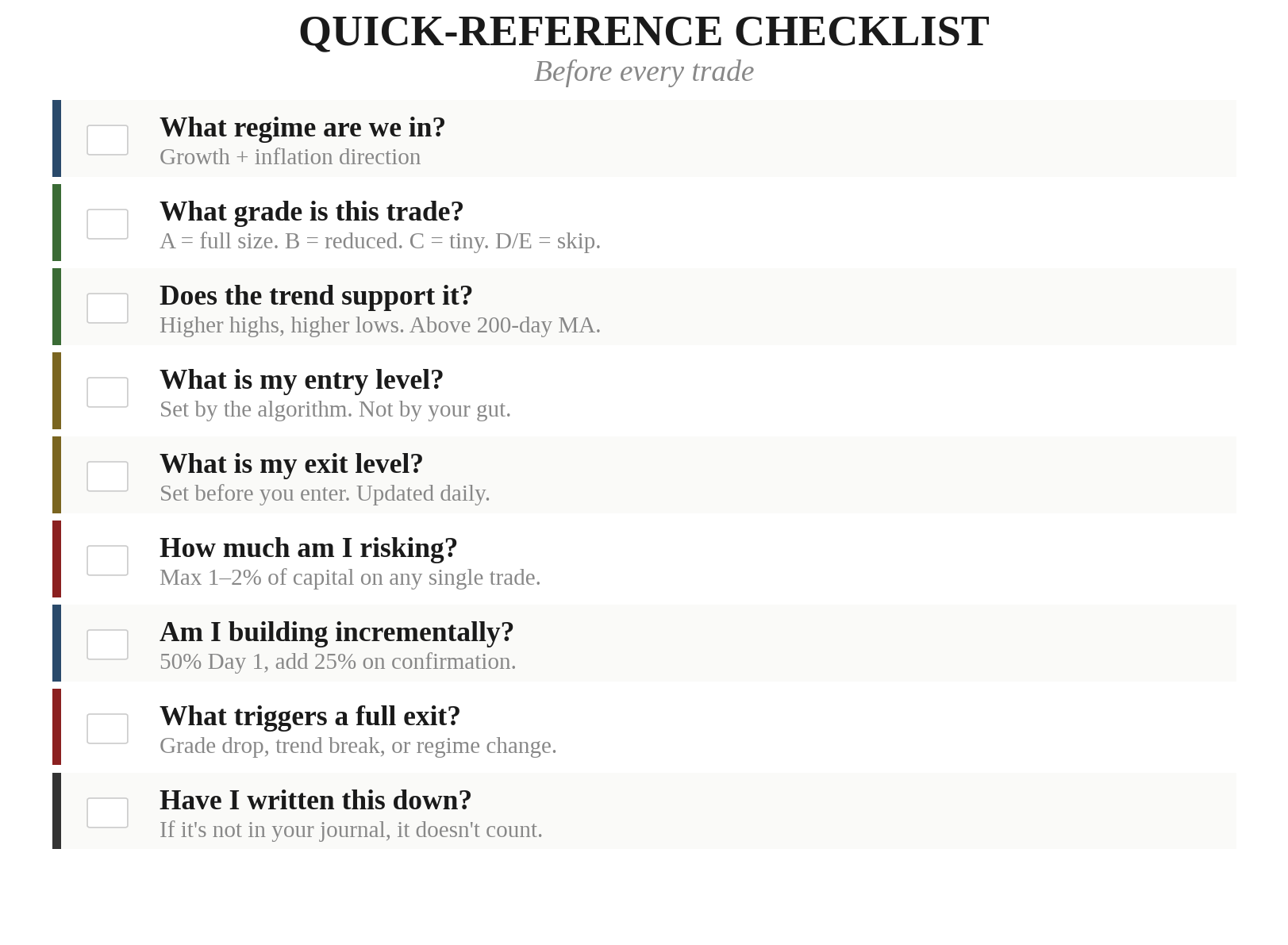
Which of the four regimes are we currently in? What data tells you this? What does the regime say about which asset classes, sectors, and style factors to favour?
Update this monthly. One paragraph is enough. Date it. Keep all of them so you can see how regimes evolve.
What specifically makes an asset Grade A for you? Both conditions must be met: mathematical signal confirmation AND macro regime support. Write it out in your own words. If you can't articulate what makes something Grade A, you're not ready to trade it.
How much of your total capital goes into a Grade A trade? A Grade B? What's your maximum single-position size? What's your maximum total exposure? Write the exact percentages. No ambiguity.
A rule like "I'll size it appropriately" is worthless. A rule like "Grade A gets 15–25% of trading capital, built over 2–3 days, never exceeding 30% of total portfolio" is actionable.
For Grade A: exit on trend break or grade downgrade. For Grade B and below: hard stop set before entry. After a loss: walk away for 24 hours, no exceptions.
Write this in advance so that when you're emotional, you have something written by your rational self to follow.
Based on your age: equity exposure percentage, leverage level (if any), bond/cash percentage. Review annually or when major life changes occur. This is your strategic backbone.
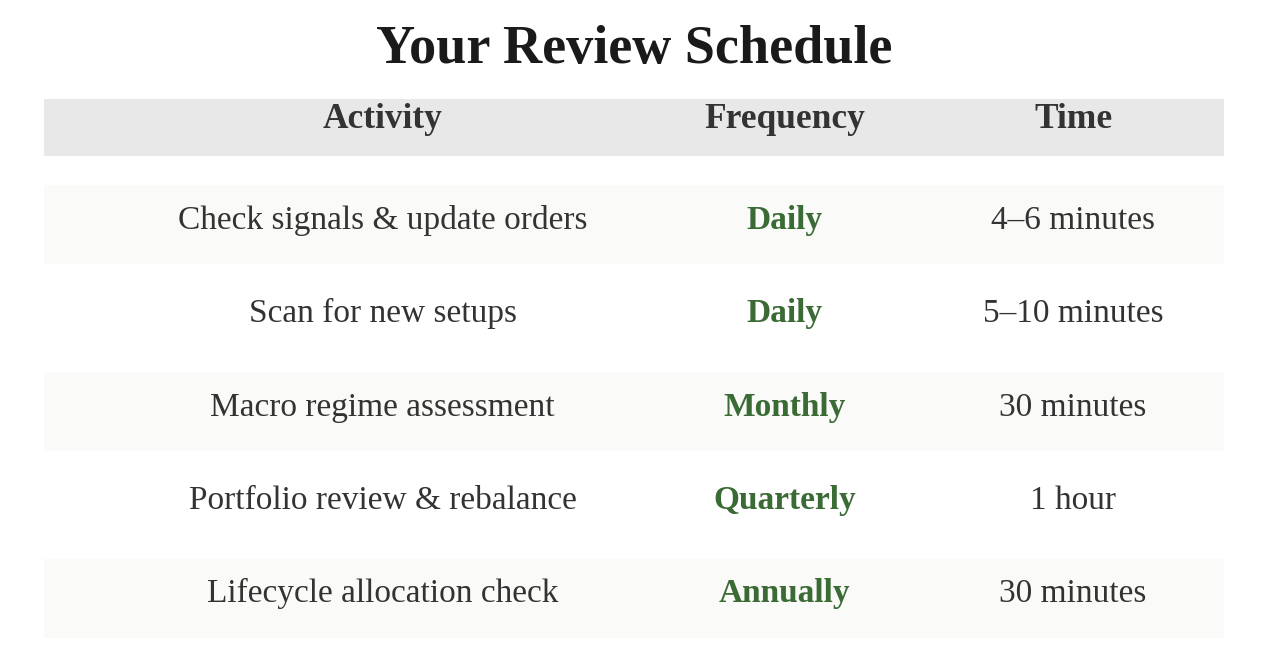
How often do you check each component? Daily signals (5 min). Monthly macro (30 min). Quarterly portfolio (1 hour). Annual lifecycle check (30 min). Write the exact schedule and stick to it.
Your Implementation Timeline
Don't try to implement everything at once. That's a recipe for overwhelm and paralysis.
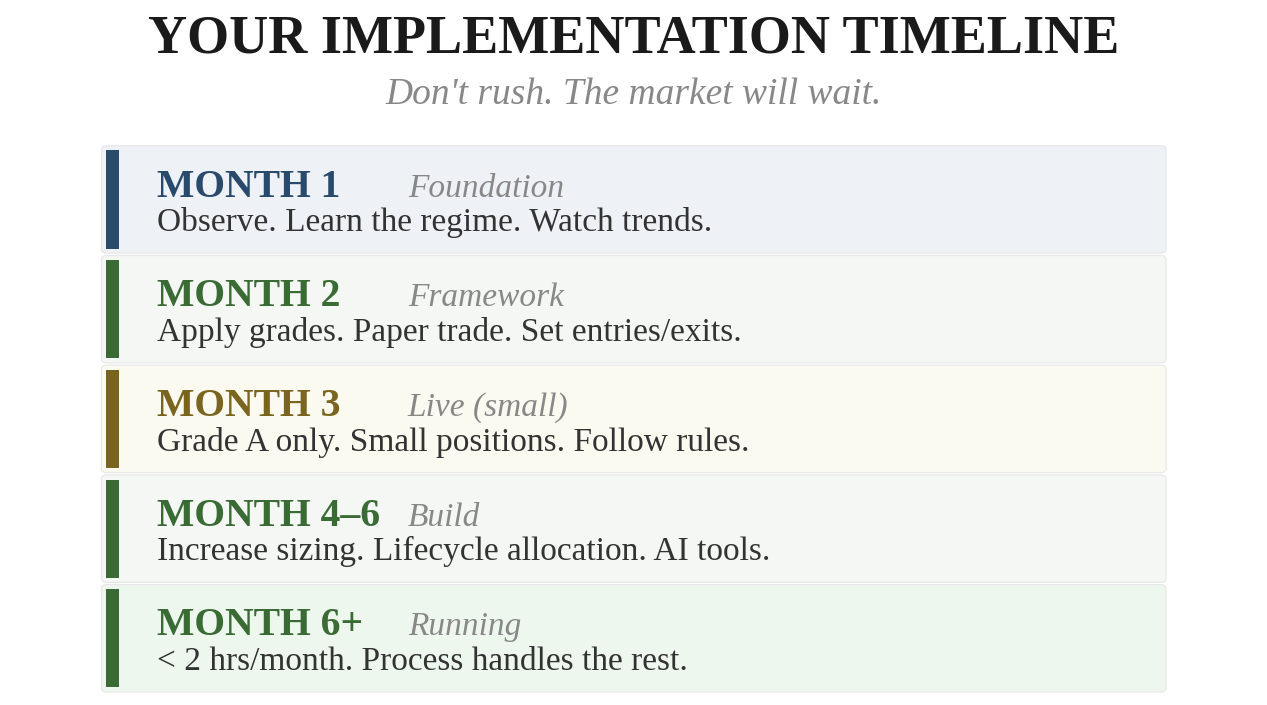
Understand price is primary. Watch the trend of what you're already invested in. Learn which macro regime we're in right now. Follow growth and inflation data. Read one weekly economic summary. Don't trade yet. Just observe.
Start applying the Grade System. Identify Grade A candidates. Paper trade — set entries and exits each morning and track results. Write in your journal every day, even without a live trade. Paper trading costs nothing and teaches everything.
Go live with small positions. Trade Grade A only. Follow your written rules exactly. If there's no Grade A setup, trade nothing. This will feel frustrating. That frustration is the market testing your discipline. Pass the test.
Gradually increase sizing. Set up your core long-term portfolio using the three pillars. Implement the lifecycle allocation. By month six, you should have both a trading process and an investing process running simultaneously.
What This Looks Like in Real Life
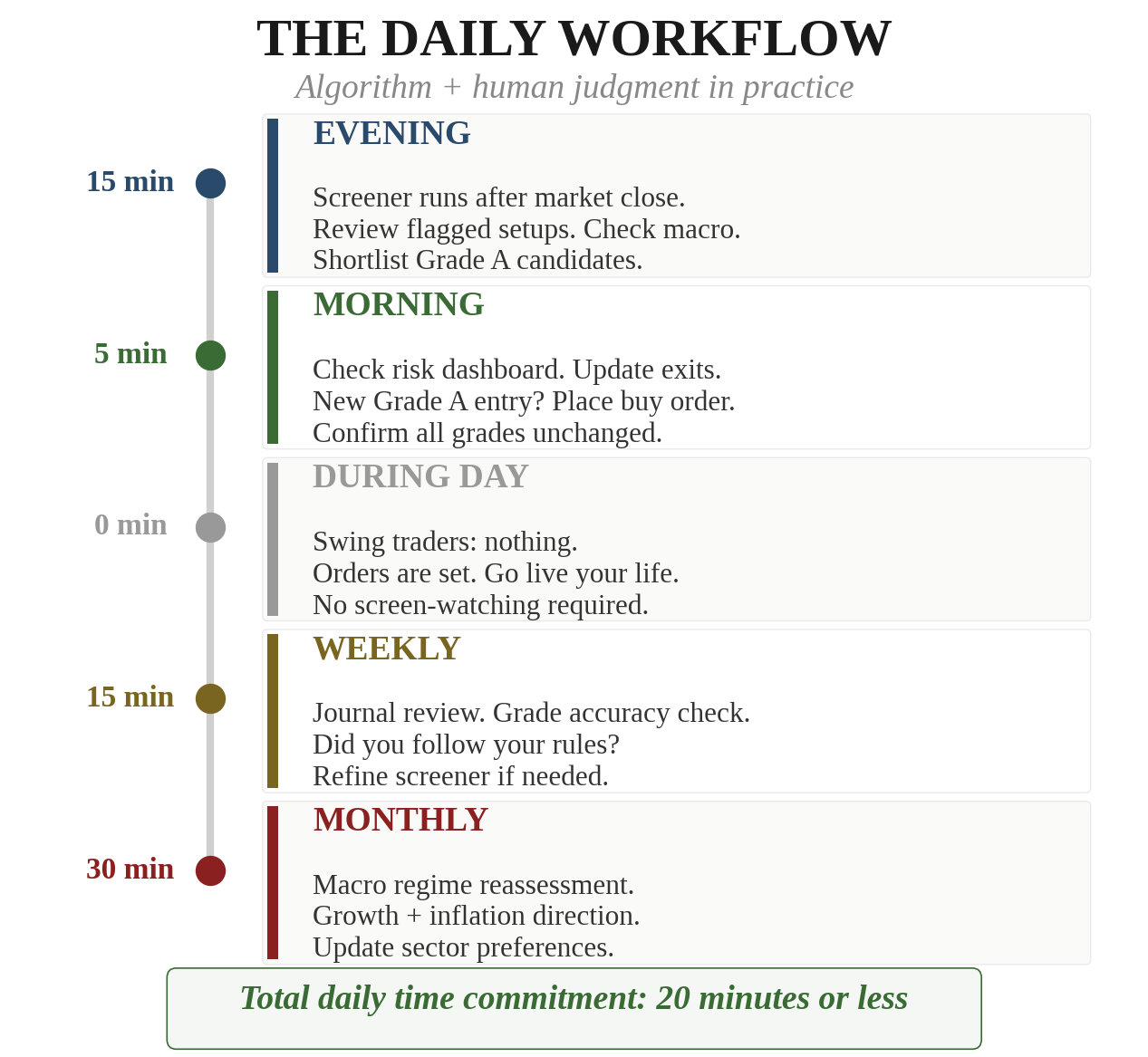
Check signals over coffee. Two assets have entry levels, both Grade B. You do nothing. 4 minutes.
A commodity gets upgraded to Grade A. Regime 2 supports it. You set a buy limit. It fills. You set the exit. 6 minutes.
Update exit level with new daily signal. Position up 1.2%. Don't check anything else. 2 minutes.
30 minutes reviewing macro regime. Growth still accelerating, inflation still rising. Regime 2 holding. Two trades this month, one win, one still open. Both followed the process. 30 minutes.
One hour reviewing long-term positions against the three pillars. All in uptrends, all sound. Check lifecycle allocation — still appropriate. Rebalance slightly. 1 hour.
That's it. In an average month, you spend less than two hours on your finances. The rest of the time, you live your life. You're not glued to screens. You're not anxious about headlines. You have a process, and the process does the work.
The Quick-Reference Checklist
The Compounding Effect of Good Decisions
You don't need to be brilliant. You don't need to predict the future. You don't need to find the next ten-bagger or catch the exact bottom of a crash. You need to make slightly better decisions than average, consistently, over a long period of time.
If you protect your capital when others are reckless, you start from a higher base. If you invest with the macro regime rather than against it, you tilt the odds. If you concentrate in Grade A trades rather than diluting across mediocre ones, your winners make a difference. If you start early and let lifecycle investing do its work, time becomes your most powerful ally.
None of these edges is dramatic on its own. Each gives you maybe 2–3% per year over the average investor. But stacked together and compounded over twenty or thirty years, the cumulative effect is transformational.
The average investor's 6%/year vs a disciplined investor's 10%/year. Over thirty years:
£100,000 at 6% → £574,000
£100,000 at 10% → £1,744,000
Same starting capital. Same markets. Three times the wealth. The gap is entirely explained by process: regime awareness, conviction grading, position sizing, and the discipline to follow the rules when it's uncomfortable.
That's what this book has given you. Not a secret. Not a shortcut. A process.
The lifecycle investing framework means the earlier you start, the more dramatically the maths works in your favour. A 25-year-old reading this book has a mathematical advantage that no amount of money can buy later — the advantage of time. Review our verified track record to see how these principles perform with real capital.
And if you're not young, it still applies. The best time to start was twenty years ago. The second-best time is today. The lifecycle framework adapts to every age. Your allocation will be different, but the principles are identical: know your regime, grade your conviction, execute with discipline, and let time do the compounding.
Now go build your playbook. The market is waiting.
If you want to see the macro regime, the grading system, and the trades applied with real money — live research, signals, and analysis across forex, futures, equities, crypto, and prediction markets — that's what Vector Ridge does every day.
Start Your 7-Day Free Trial- 1.Write down your six rules: regime assessment, grade criteria, position sizing, exit rules, lifecycle allocation, and review schedule.
- 2.Implementation timeline: Month 1 observe, Month 2 paper trade, Month 3 live small, Months 4-6 build full system.
- 3.You don't need to be brilliant — slightly better decisions compounded over decades turn £100,000 at 6% (£574k) into 10% (£1.74M). Three times the wealth from process alone.
This content is for educational purposes only and does not constitute investment advice. Trading and investing involve substantial risk of loss. Past performance is not indicative of future results. Always do your own research and consider seeking professional guidance before making financial decisions.