
You've read Chapter 13. You understand the odds. You understand the costs. You understand the structural disadvantages. And you're still here.
Either you have the capital, the infrastructure, and the temperament to give it a genuine shot, or you're here because the microstructure knowledge from Chapter 14 is valuable regardless of your timeframe. Both are valid reasons. Here's how to do it right.
The Only Three Trades Worth Trading
Most day traders take too many trades. The research is clear: the fewer trades a day trader takes, the more likely they are to be profitable. The profitable minority trade 2–5 times per day. The unprofitable majority trade 15–30 times. You need exactly three trades. Not thirty. Three.
Setup 1: The Opening Range Breakout
The first 30 minutes are chaos. After that settles, the stock establishes a range: a high and a low. If price breaks above the range high on strong institutional volume, you buy. If it breaks below the range low on the same, you sell short.
The opening range represents the market's first attempt at price discovery. When it breaks, it often signals the direction for the rest of the session.
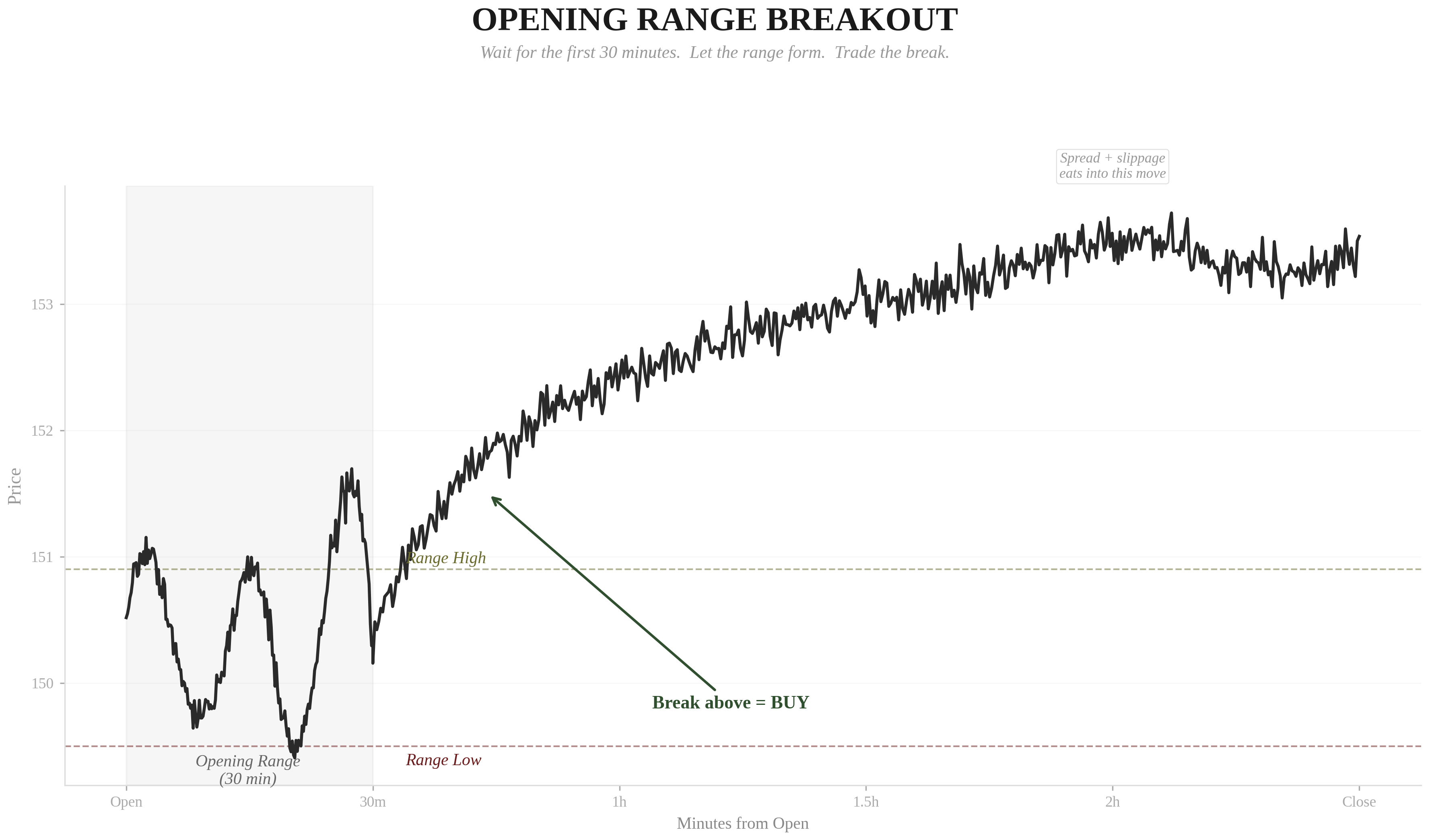
The confirmation is critical. A breakout on light volume and small orders is a trap — retail traders chasing, market makers will fade it. A breakout on heavy volume with large blocks is institutional. That's the one you trade.
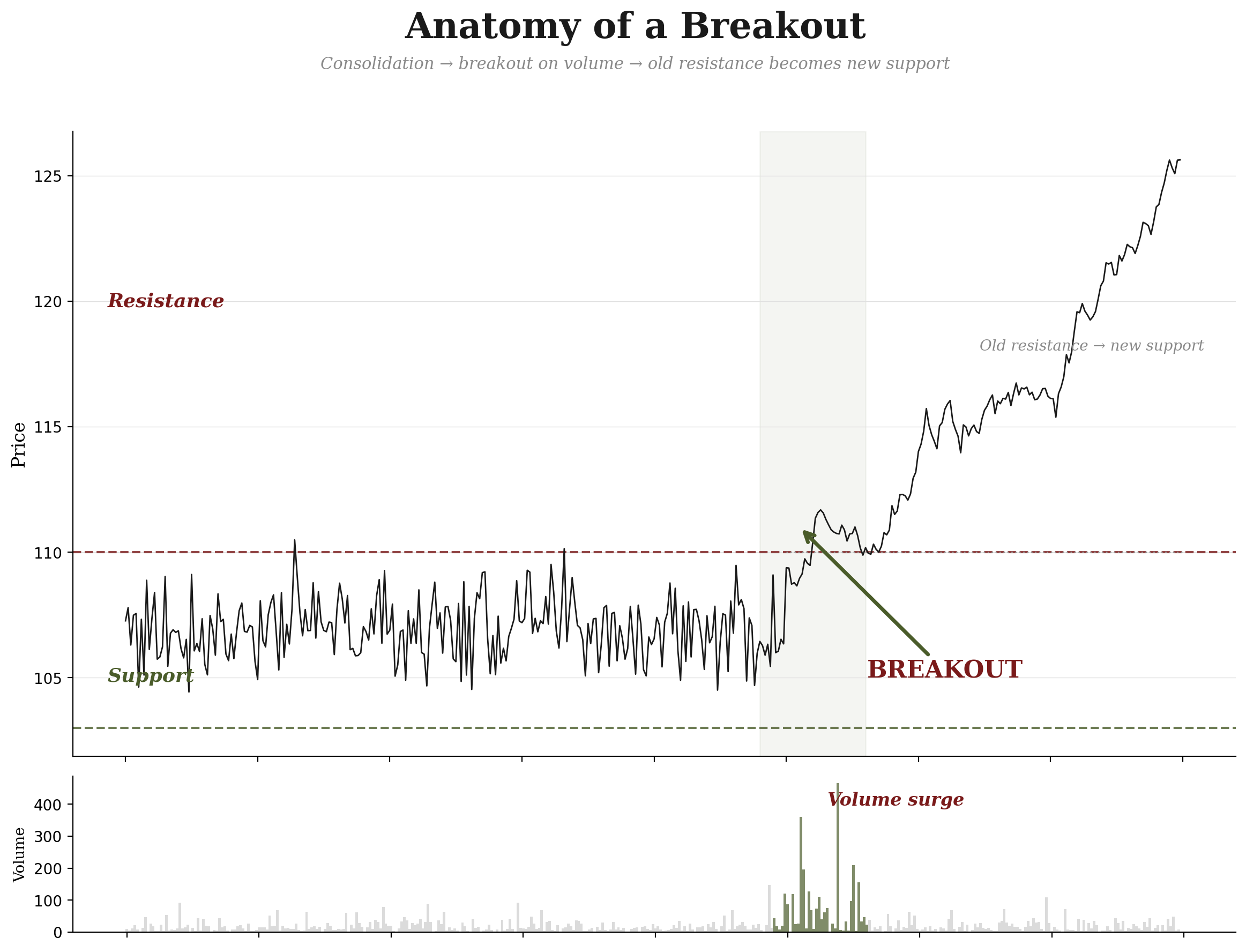
Your stop goes just inside the opening range. If price breaks out above the range at 146.50 and the range low was 145.80, your stop goes at 146.00. Your target is typically 1.5–2x the height of the opening range.
Setup 2: The VWAP Reclaim
A stock opens weak, trading below VWAP. It sells off for the first hour, finds a low, and begins to grind higher. When it crosses back above VWAP on increasing volume with institutional-sized orders, sellers have been exhausted and buyers are taking control.
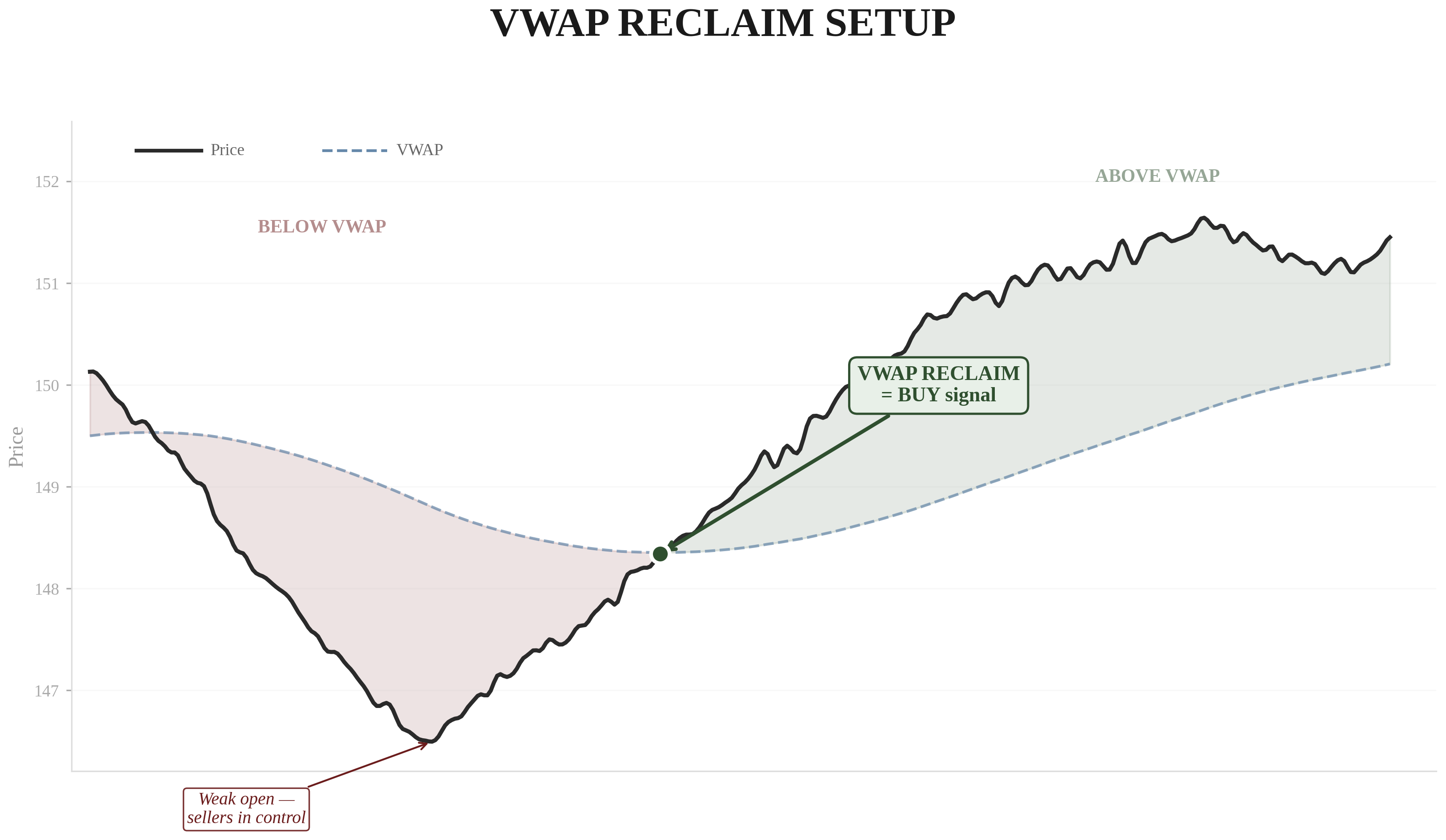
Enter when price crosses above VWAP and holds for 2–3 minutes. Not the first touch — that's often false. Wait for the push above, a slight pullback, then confirmation of hold. Stop below the pullback low. Target is the Point of Control or the session high.
Setup 3: The Institutional Absorption
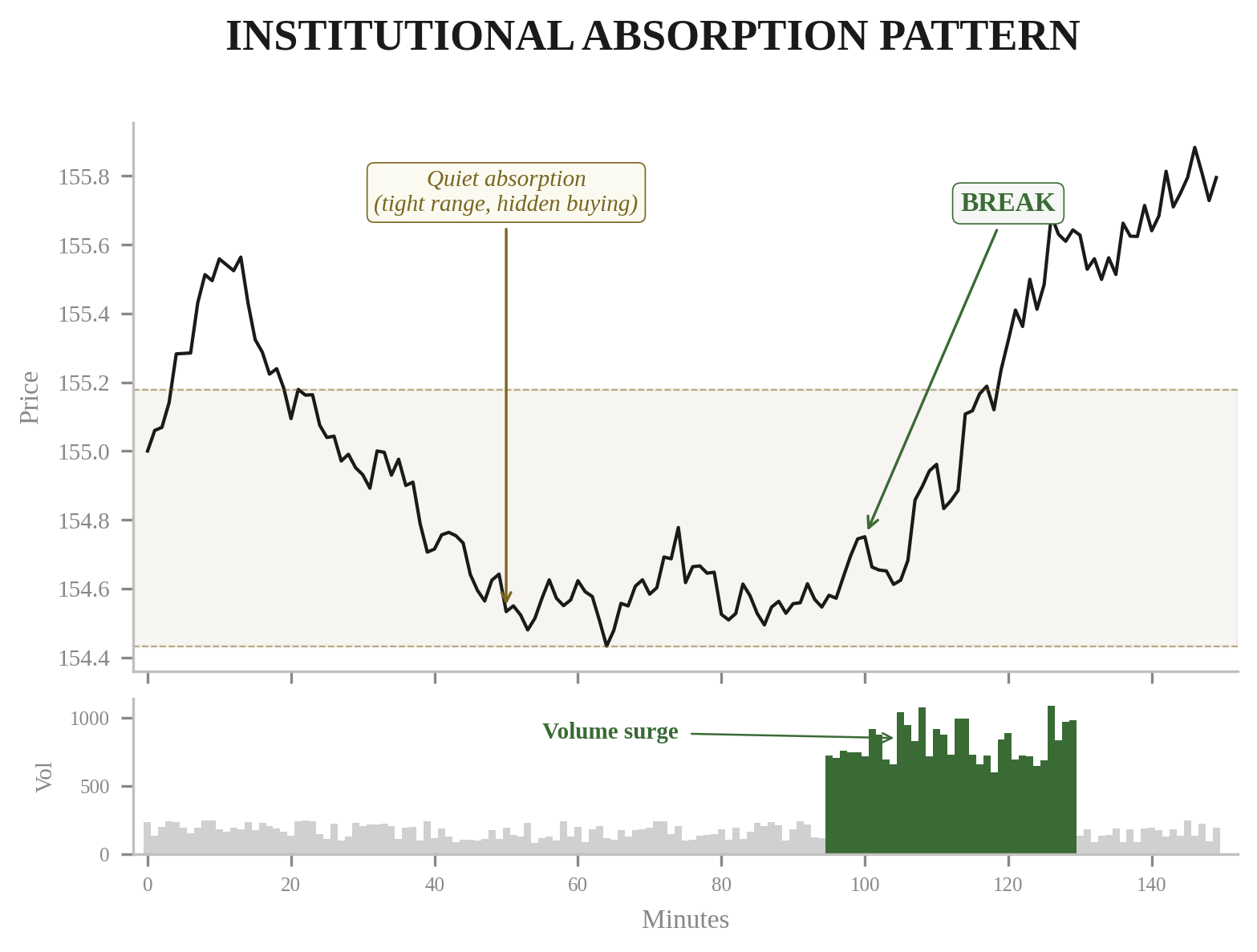
The most advanced setup and the highest win rate when identified correctly. A large player is accumulating without letting the price move. Every time sellers push down, a large bid absorbs the selling. The price dips, gets bought, dips again, gets bought.
The trade triggers when the absorption ends and price breaks higher. Your entry is the break of the consolidation high. Your stop is below the consolidation low. Target is aggressive — the pent-up buying pressure drives sharp moves.
I've seen absorption trades produce some of the cleanest intraday moves — quiet accumulation for 90 minutes followed by a 2–3% breakout in under an hour. But identifying them requires genuine order flow reading skill. Only the order flow tells you whether the buying is institutional or retail.
A Worked Day Trade: Opening Range Breakout
Pre-market: Large-cap tech reported strong earnings. Pre-market volume 5x normal. Stock gapped up 3% overnight. Macro: Regime 1. This stock is on your watchlist.
Market opens. Stock gaps to 178.50, immediately sells off to 176.80. Buyers step in. Pushes to 179.20. More selling. Dips to 177.50. Chaos. You don't touch it. Defining the opening range.
Watching — defining rangeOpening range set: 176.80 to 179.20. A £2.40 range. You need a breakout above 179.20 or below 176.80 on institutional volume.
Range defined — waitingStock pushes to 179.00 on small orders. Retail buying. No institutional blocks. Falls back to 178.20. False alarm. You do nothing.
Fake breakout — no entrySomething changes. 15,000-share block hits the ask at 178.80. Then 8,000 at 179.00. The ask at 179.20 gets consumed by 12,000 shares. A 5,000-share iceberg bid appears at 179.10. Institutional demand is unmistakable.
Institutional breakout confirmedBuy at 179.35. Stop at 178.50 (inside range). Target: 1.5x range = £3.60, so ~182.80. Risk: £0.85/share. Reward: £3.45/share. Risk-reward: ~4:1.
Entry at 179.35Stock pushes to 180.50. Up £1.15/share. Volume strong. VWAP below and rising. Institutional buying continues. Hold.
+£1.15 — holdingStock hits 181.80 and stalls. Volume declining. Sellers appearing at 182.00 with institutional size. Order flow shifting. Take profit at 181.70. Gain: £2.35/share.
Exit at 181.70 — +£2.35/shareOne trade. 36 minutes. On 500 shares: ~£1,175 gross, ~£1,140 net after costs. Then close the screen.
You didn't trade the first 30 minutes. You didn't chase the fake breakout at 10:12. You didn't hold to target when order flow showed sellers arriving. And you stopped after one trade. Four decisions. All correct.
Risk Management for Day Trading
If you lose 1% of your account in a single day, you stop trading. Close your platform. Walk away. On a £100,000 account, that's £1,000. If two trades lose £500 each, you're done for the day. No "one more trade to make it back."
The profitable day traders take fewer trades. More trades equals more costs, more emotional decisions, and more noise exposure. If you don't see a clean setup from the three playbooks, you don't trade. Sitting on your hands is a position.
Stop trading after the first two hours. The midday session (11:30am–2:00pm) is a graveyard for day traders: volume drops, spreads widen, and the few moves that happen are dominated by algorithms. Close the screen at 11am on a profitable morning and go for a walk.
A veteran day trader once told me: "Every day the market is open, I'm looking for a reason not to trade. Most days I find one."
When to Stop Day Trading
Account down 20% from peak. A 20% drawdown requires 25% to break even. If you're down 20%, the system isn't working. Reassess completely.
Can't follow the loss limit. If you've violated the 1% daily loss limit more than twice in a month, you don't have the discipline. That's not an insult — it's a diagnostic.
Health is suffering. Chronic stress, poor sleep, weight gain, relationship problems, anxiety when not trading. No trade is worth your health.
Not profitable after 6 months. Traders who aren't showing profitability within 6–12 months rarely become profitable. The research is clear on this.
After six months of full-time day trading — roughly 1,000 hours of screen time — a typical unprofitable day trader has lost 15–30% of their capital.
In those same six months, a swing trader following Part Three, spending 20 minutes per day, would have had the opportunity to make 50–80%.
The Bigger Picture
Day trading is one approach among many. It's the hardest, the most time-consuming, the most stressful, and — for the vast majority — the least profitable. It exists in this book because some people will pursue it regardless, and they deserve honest tools rather than fantasy promises. For most traders, the full trade service covering swing trades across six markets is the smarter path.
The time horizon you trade on is a choice, not an identity. The best traders aren't loyal to a timeframe — they're loyal to what works. For 95% of people, that's not day trading. Use our free calculators and tools to figure out what works best for your capital and lifestyle.
If you're one of the 5%, these chapters have given you the tools. If not, Part Three is waiting for you. There's no shame in choosing the approach with better odds.
Part Four complete. Next: Part Five — Algorithmic & Systematic Trading. The rules have changed, and the change favours you.
- 1.Only three trades are worth trading: Opening Range Breakout, VWAP Reclaim, and Institutional Absorption.
- 2.The 1% daily loss limit is non-negotiable — if you hit it, close the screen immediately.
- 3.Stop trading after the first two hours. The midday is a graveyard for day traders.
This content is for educational purposes only and does not constitute investment advice. Trading and investing involve substantial risk of loss. Past performance is not indicative of future results. Always do your own research and consider seeking professional guidance before making financial decisions.