Imagine you're a farmer. You don't plant seeds in the dead of winter. You plant them in spring, when conditions are right. You harvest in autumn. You prepare for winter before the first frost hits.
If you planted corn in December, it wouldn't matter how good your seeds were, how fertile the soil was, or how hard you worked. The season was wrong. The conditions were against you. You'd lose everything.
Markets work exactly the same way. The economy moves through seasons, and different assets perform dramatically better or worse depending on which season we're in. If you can figure out which season we're in, you can put your money in the right place at the right time — and let the season do the heavy lifting.
This chapter teaches you how to read the economic weather. It's the foundation that everything else in this book sits on.
The Only Two Variables That Matter
There are thousands of economic data points published every month. GDP, employment numbers, manufacturing indices, consumer confidence, housing starts, retail sales, trade balances, money supply, credit spreads — the list goes on forever.
Most people try to track all of them. They drown in data. They get confused by contradictory signals. One number says the economy is great, another says it's terrible.
The secret? Of all those data points, only two matter most for predicting which assets will perform well:
1. Economic Growth — Is the economy speeding up or slowing down?
2. Inflation — Are prices rising faster or slower?
That's it. Two variables. Growth and inflation. Everything else is noise.
But here's the crucial part that most people miss: we don't care about the absolute level. We care about the direction. We care about the rate of change.
It doesn't matter if GDP growth is 2% or 4%. What matters is whether it's accelerating or decelerating. Is 2% heading toward 3%? Or is 4% heading toward 2%? The direction tells you where the economy is going. The direction tells you what the central bank will do next. And the central bank's response is what moves every single market on the planet.
Think of it like driving a car. The police officer doesn't care that you're going 60 mph. He cares whether you're speeding up or slowing down. If you're accelerating toward 90, that's a very different situation than if you're decelerating from 70 to 50.
The Four Macro Regimes
When you combine the direction of growth with the direction of inflation, you get four possible environments — four seasons of the economy. Each one tells you which assets tend to perform best and which tend to suffer.
Understanding these four regimes is like having a GPS for your money. It won't tell you exactly which stock to buy, but it will tell you what continent you should be on.
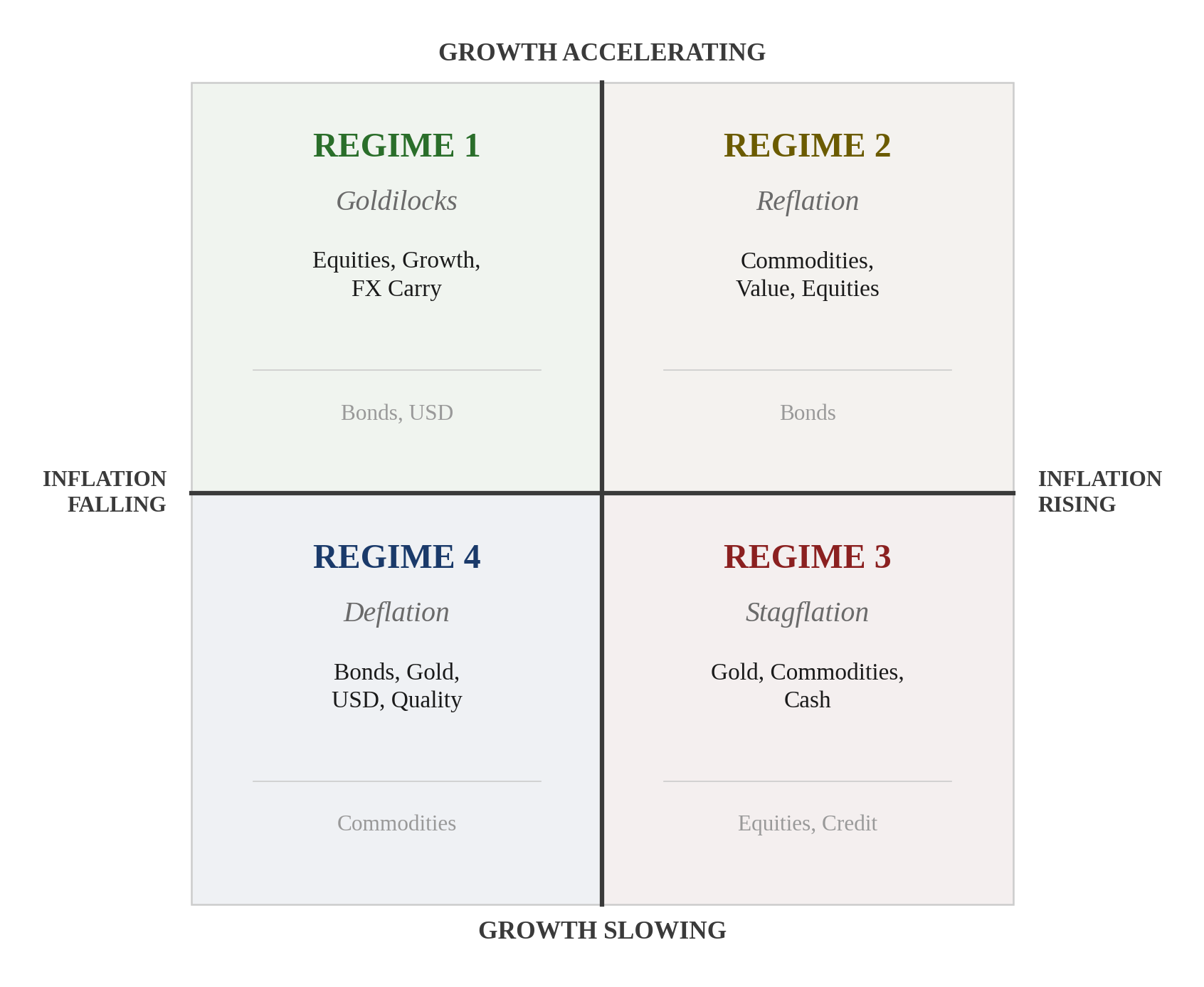
Regime 1: Growth Accelerating, Inflation Slowing
The economy is humming along, businesses are growing, employment is strong — but prices aren't out of control. Central banks are relaxed. Liquidity is flowing. Risk appetite is high.
Think of 2017 or most of 2024. The economy was growing nicely, inflation was cooling, and the stock market just kept grinding higher month after month. If you were long equities during those periods, you barely had to do anything. The regime was doing the work for you.
This is the best environment for equities, particularly growth stocks and technology. Commodities and foreign currencies also tend to do well. Fixed income and the US dollar tend to underperform because there's no reason for investors to hide in safe havens.
Regime 2: Growth Accelerating, Inflation Rising
Growth is strong and prices are rising. Everything is booming — but the heat is building. Demand is outstripping supply. Commodities surge. The central bank starts getting hawkish.
Think 2021 — the post-pandemic reopening. Everyone was spending. Supply chains were wrecked. Demand was outstripping supply across the board. Commodities went vertical. Oil, copper, lumber — everything with a price tag was ripping higher. Equities were rising too, especially value and cyclical stocks that benefit from economic activity.
But this regime is a trap if you're not paying attention. Everything feels good — the economy is growing! — but the inflation part means the central bank is getting hawkish. Rate hikes are coming. And when they arrive, they choke off the boom. The trick is to ride it while it lasts, but know that the music will stop.
Regime 3: Growth Slowing, Inflation Accelerating
The economy is slowing down but prices are still running hot. The worst of both worlds. The central bank is stuck — they want to cut rates but inflation won't let them.
The first half of 2022 was a textbook Regime 3. Growth was rolling over, inflation was still at 8–9%, and the central bank was hiking rates into a slowing economy. The S&P 500 dropped over 20%. The Nasdaq fell 33%. Meanwhile, gold held steady and energy stocks surged.
This is the environment where the usual playbook of "buy the dip" stops working. Every dip leads to another dip. The central bank is stuck — they want to cut rates to help growth, but inflation won't let them. Gold and commodities are your friends. Most equities are your enemy.
Regime 4: Growth Slowing, Inflation Slowing
Everything is cooling off. The economy is contracting and prices are falling. Headlines are apocalyptic. But the central bank is cutting rates aggressively — bonds rally hard, and eventually the next cycle begins.
Think late 2008, or early 2020. The feeling in the air is dread. Headlines are apocalyptic. Your neighbour is panicking about their 401(k).
But here's the thing — if you understand the regime, you're not panicking. You're positioning. The central bank will almost certainly be cutting rates aggressively to stimulate the economy, which makes bonds extremely attractive — when rates fall, bond prices rise. This is one of the most predictable and profitable trades in all of finance.
The US dollar tends to strengthen as a safe haven. Gold benefits from the fear and falling rates. Equities, especially cyclical ones, get hammered because earnings are declining. Commodities fall because demand is evaporating.
This is the environment where cash is king and capital preservation matters more than anything else.
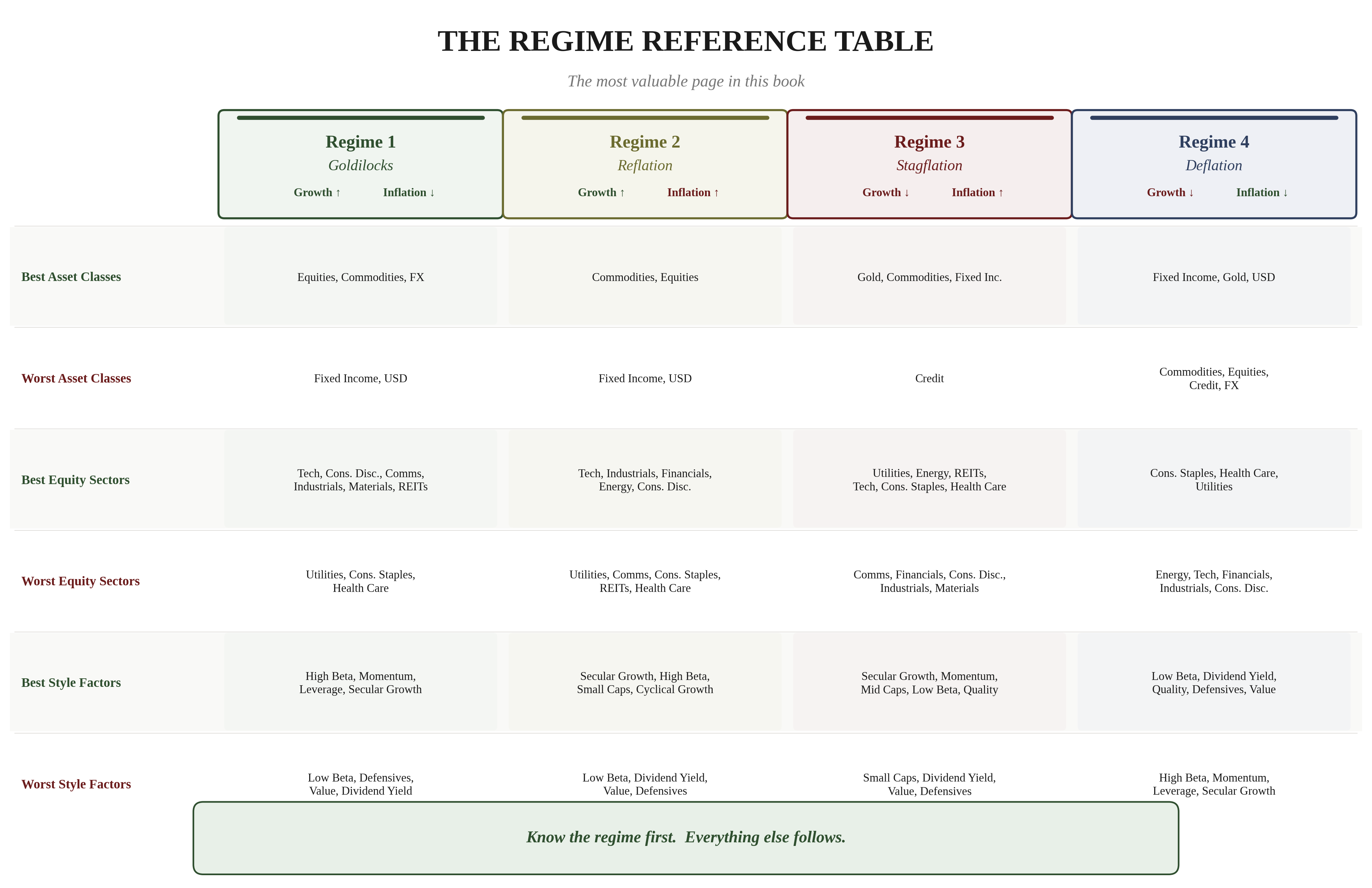
The Full Regime Reference Table
Below is the complete picture in one table. This is probably the single most valuable page in this entire book. Bookmark it. Print it. Put it next to your trading screen.
Predicting the Central Bank
Once you know which regime you're in, you unlock something that most traders would pay a fortune for: the ability to predict what the central bank is likely to do next.
Think about what that means. When the central bank moves, everything moves. Stocks, bonds, currencies, commodities, real estate — trillions of dollars reposition in response to a single rate decision. Most people find out what happened at 2pm when the statement comes out. By then, it's too late. The move has already happened.
But if you understand the regime, you already know what's coming. Not the exact timing, but the direction. And the direction is worth a fortune.
Regime 1 (Growth ↑, Inflation ↓) — Central bank is neutral or slightly dovish. No urgency to act. The Goldilocks environment for stocks.
Regime 2 (Growth ↑, Inflation ↑) — Central bank gets hawkish. Rate hikes incoming. Bond prices fall. Commodities benefit.
Regime 3 (Growth ↓, Inflation ↑) — Central bank is stuck. They'd love to cut but inflation won't let them. Gold benefits from the uncertainty.
Regime 4 (Growth ↓, Inflation ↓) — Central bank goes full dovish. Rate cuts, liquidity injections, rescue mode. Bonds rally hard.
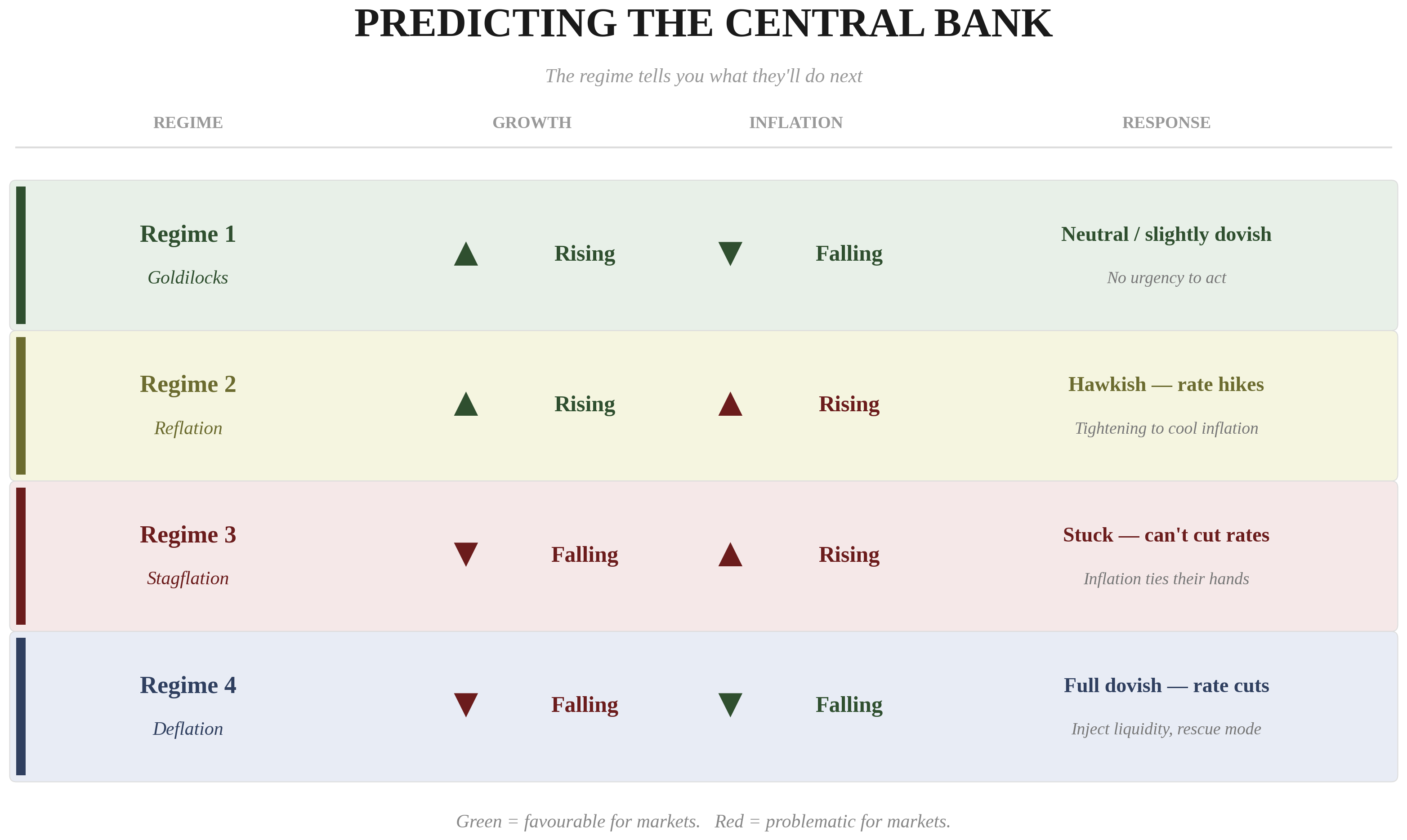
The regime tells you where you are. The central bank's likely response tells you where you're going. And where you're going tells you what to buy or sell today. To see how this plays out with live trades, take a look at our free sample signals.
How to Track Which Regime You're In
You don't need a PhD or a Bloomberg terminal to figure out which regime you're in. You just need to follow a handful of data points and watch the direction. We also provide free tools and calculators that can help you track these macro indicators.
Let me walk you through what this looks like in practice. Say it's January. You pull up the latest GDP report. Last quarter, growth was 2.1%. The quarter before that, 1.8%. The quarter before that, 1.4%. The trend is clear: growth is accelerating. Check.
Now you look at the latest CPI (inflation) report. Year-over-year inflation was 3.8% last month, 4.1% the month before, 4.5% before that. The trend: inflation is decelerating. Check.
Growth accelerating plus inflation decelerating — that's Regime 1. The sweet spot. You now know that equities, commodities, and FX should be your hunting ground, and you should be avoiding fixed income and the US dollar. You know the central bank is likely to be neutral or dovish. You know which sectors to overweight and which style factors to favour.
All of that from looking at two numbers and their direction. Nothing more.
For growth: GDP (quarterly), employment reports (monthly), manufacturing and services PMI (monthly). Ask one question: is the year-over-year rate of change getting bigger or smaller?
For inflation: CPI and PPI (both monthly), wage growth data. Same question: accelerating or decelerating?
For policy signals: Central bank meeting minutes, press conferences, and forward guidance. What language are they using? Worried about inflation? That's hawkish. Worried about growth? That's dovish.
The regime typically lasts months or even quarters. This isn't about predicting next week's data. You're identifying the multi-month trend and positioning accordingly. When the trend shifts, the regime shifts, and you rotate.
This is the macro half of the equation. The next chapter covers the mathematical half — a grading system that tells you exactly how confident to be on each trade.
- 1.Only two variables matter: the direction of growth and the direction of inflation. Everything else is noise.
- 2.The four regimes (Goldilocks, Reflation, Stagflation, Deflation) tell you which assets to buy and which to avoid.
- 3.Understanding the regime lets you predict central bank actions before the market prices them in.
This content is for educational purposes only and does not constitute investment advice. Trading and investing involve substantial risk of loss. Past performance is not indicative of future results. Always do your own research and consider seeking professional guidance before making financial decisions.