I need to start this chapter by being more direct than most trading books are willing to be.
The vast majority of people who try day trading lose money. Not "make a little less than expected." Lose money. Actual, real, painful losses that damage their savings, their confidence, and sometimes their lives.
A similar study in Brazil tracked all day traders who opened accounts over a three-year period. Of those who traded for more than 300 days — the committed ones — only 3% made any profit at all. The average loss among the remaining 97% was significant.
I'm telling you this not to discourage you, but because no one else will. The day trading industry — the courses, the trade services, the Discord groups, the YouTube channels — survives by selling the dream. They make money from your tuition fees, your subscriptions, and your brokerage commissions. Whether you make money is irrelevant to their business model.
Why Day Trading Is So Hard
The Speed Problem
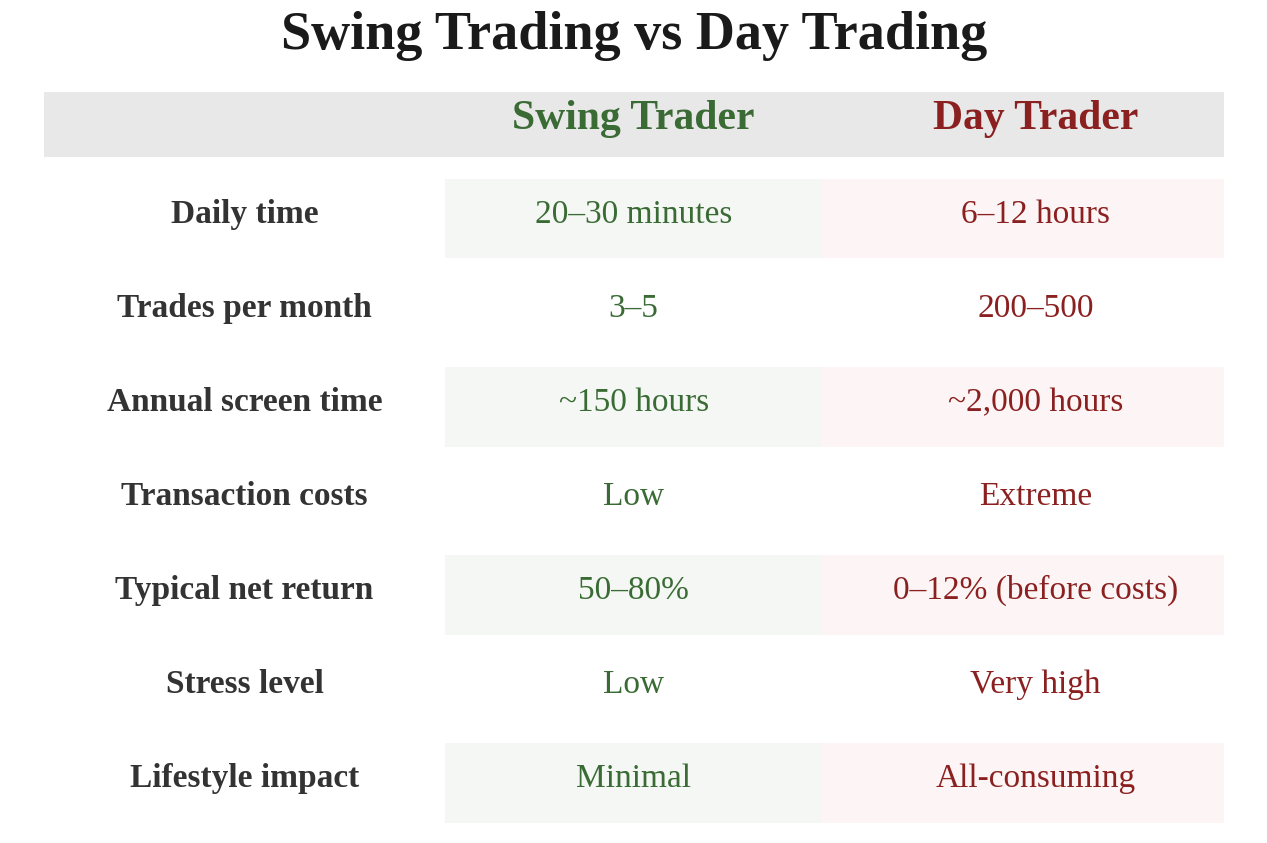
When you day trade, you're competing against computers that read, analyse, and execute trades in microseconds. On the daily chart, the speed disadvantage doesn't matter — whether you enter at 142.00 or 142.15 is irrelevant over a 10-day hold.
But on the 1-minute chart, that 15p difference is your entire profit margin. A high-frequency trading firm's average profit per trade is less than one penny per share — but they make millions of trades per day. Their edge is volume and speed. Two things you will never have.
The Cost Problem
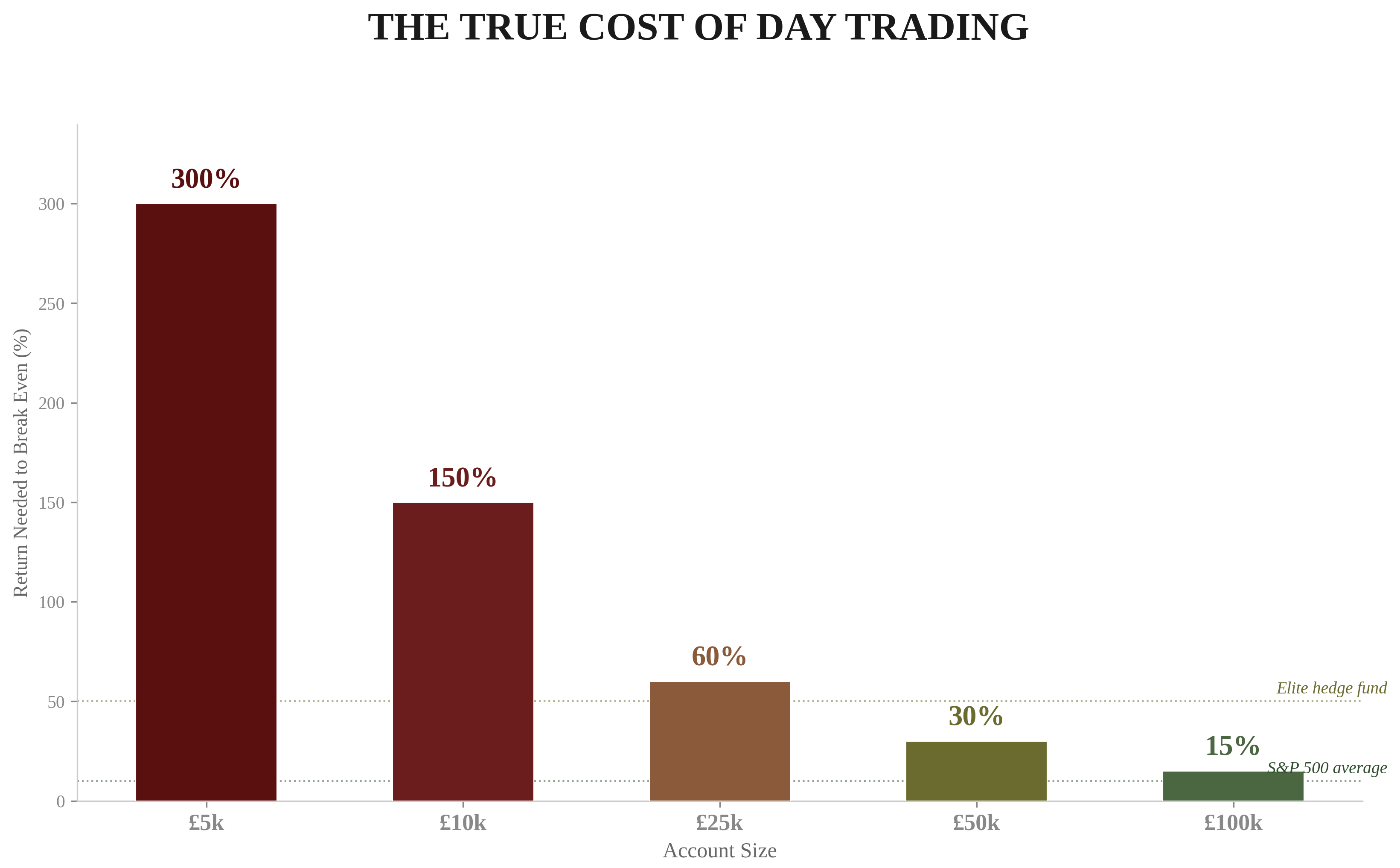
Every time you buy and sell, you pay costs. Commission, spread, slippage. On a swing trade targeting 5%, paying 0.1% in total costs is nothing. But on a day trade targeting 0.3–0.5%, those same costs eat 20–30% of your gross profit.
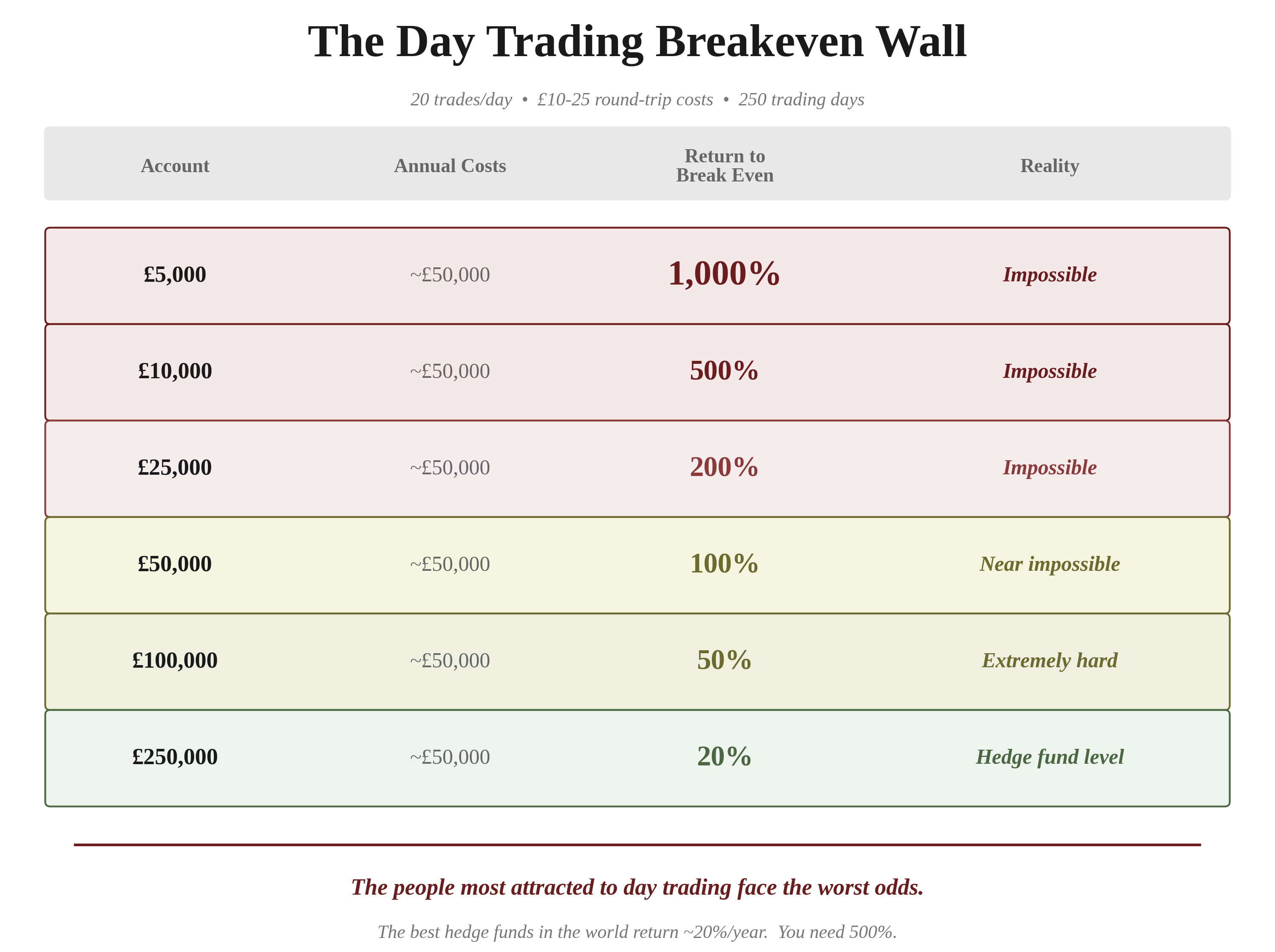
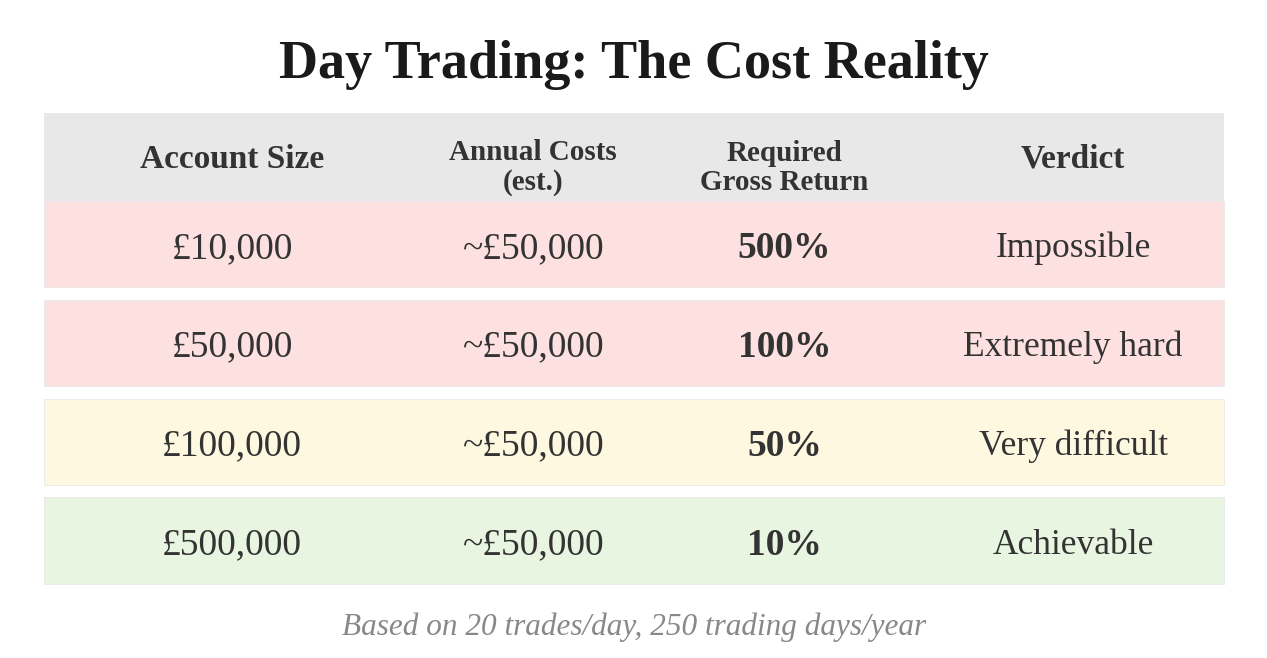
Let me put real numbers on this. You're day trading with a £10,000 position, targeting a 0.5% move — £50 profit. Broker charges £5 per trade (£10 round trip). Spread costs another £5 each way. Slippage adds £3–5. Your £50 gross profit becomes £25–30 net. Nearly half gone to friction.
Multiply across 20 trades per day, 250 trading days per year. That's 5,000 round trips. Even at modest rates, you're paying £50,000+ in annual transaction costs. To break even, you need to generate over £50,000 in gross trading profit on a £10,000 account. That's a 500% gross return — to break even.
Every "start with £1,000 and become a millionaire" pitch, every social media guru showing "daily profits" from a £10,000 account — they're either lying about their results, ignoring their costs, or making their real money from selling courses to you.
The Noise Problem
On the 1-minute chart, roughly 70–80% of what you see is statistical noise — random fluctuations with no predictive value whatsoever. You're staring at a chart that is mostly lying to you, trying to extract meaning from patterns that are indistinguishable from randomness.
Nobel Prize-winning economist Daniel Kahneman described "the illusion of skill" — the tendency to see patterns in random data and attribute them to expertise. This is devastating for day traders. You look at a 1-minute chart, see a "pattern," trade it, and it works. You conclude you have a skill. But you might have just gotten lucky on a coin flip.
The most dangerous version of this is the day trader who has a "good week." Five winning days in a row. They feel invincible. They increase their size. The following week, the luck reverts, and they lose everything they made plus more.
The Psychological Problem
Neuroscientists have studied the brain activity of gamblers and day traders and found striking similarities. Both show activation in the ventral striatum — the brain's reward centre — in response to uncertain financial outcomes.
The variable reinforcement schedule (sometimes you win, sometimes you lose, and you never know which) is the same mechanism that makes slot machines addictive. You can lose £500 in a morning and still feel compelled to keep trading because your brain is chasing the next dopamine hit.
Studies on traders' cortisol levels show that day traders experience chronic stress comparable to emergency room doctors and air traffic controllers. The difference is that ER doctors are saving lives. Day traders are usually losing money while destroying their health.
Intelligent, analytical, had a good job in consulting. Quit to day trade full-time in early 2020. Had £45,000 saved. Set up three monitors. Started during the COVID crash — the easiest market in a generation. Made money immediately.
Then the market normalised. His edge disappeared. He started overtrading. Ten trades a day. Then fifteen. Then twenty. Costs skyrocketed. Sleep deteriorated. Stopped exercising. Started eating at his desk.
By month five, down 35% from his peak. By month nine, he'd lost £28,000 of his original £45,000. He went back to consulting.
His story is not unusual. It's the median outcome.
The Survivorship Bias Machine
If day trading is so hard, why does it seem like everyone is making money?
Because you only see the winners. This is survivorship bias — one of the most powerful and dangerous cognitive distortions in all of finance.
The day trader on social media with 500,000 followers showing screenshots of winning trades? They're real. Those trades happened. What you don't see are the losing trades they don't post. The periods of drawdown they don't mention. The ten people who tried the exact same strategy and lost everything.
Imagine 10,000 people flipping coins. After five years, roughly 312 will have gotten heads five times in a row. Those 312 will genuinely believe they have a coin-flipping skill. They'll write books about it.
The day trading industry is built on this selection bias. For every visible success, there are hundreds of invisible failures. Failed day traders don't start YouTube channels. They quietly close their accounts, absorb the shame, and move on.
Who Succeeds at Day Trading
Some people do make money day trading. Not many, but some. They share specific characteristics:
Large accounts — typically £250,000+. Transaction costs are a manageable percentage of capital, not a death sentence.
Professional-grade infrastructure. Fast internet. Direct market access. Low-latency execution. Level 2 order book data. Not a phone app.
Genuine edge in market microstructure. They understand order flow, market-maker behaviour, dark pools, and how institutional orders move price at the millisecond level.
Years of screen time. Not months — years. Typically 3–5 years of painful learning and significant losses before becoming consistently profitable.
Iron emotional discipline. They can take five consecutive losses without flinching, without revenge trading, without increasing size. They can sit for three hours without a trade because nothing meets their criteria.
If you have all five of these characteristics, day trading may be viable for you. If you're missing even one, the odds are heavily stacked against you.
The Honest Decision
Do you have £250,000+ for a day trading account? Do you have professional infrastructure? Do you have 3–5 years of living expenses saved? Do you have the emotional constitution to handle daily losses?
If the answer to any of these is no, swing trading is the better path. Not because day trading can't work — but because the expected value calculation is dramatically worse. You're spending 10x the time for a lower probability of success, higher stress, and worse risk-adjusted returns.
The next two chapters exist because this book would be incomplete without covering day trading. Some of you will have the capital, the infrastructure, and the temperament. Others will find value in understanding how intraday markets work even if they trade on longer timeframes. For most readers, our swing-oriented market products will be a far better fit.
But promise me this: if you try day trading and after 3–6 months your account is shrinking, your stress levels are rising, and you're not enjoying the process — come back to this chapter and re-read it. Then switch to swing trading. There's no shame in choosing the approach with better odds. We have free tools and resources to help you find your edge.
Next: the actual mechanics of day trading for those who choose to pursue it — or for those who want to understand how intraday markets work.
- 1.Less than 1% of day traders are consistently profitable — this is documented academic fact, not opinion.
- 2.Transaction costs make day trading with less than £100,000 almost mathematically impossible to profit from.
- 3.If you're not profitable after 6 months of disciplined day trading, switch to swing trading — no shame in choosing better odds.
This content is for educational purposes only and does not constitute investment advice. Trading and investing involve substantial risk of loss. Past performance is not indicative of future results. Always do your own research and consider seeking professional guidance before making financial decisions.