
Owning fifty different stocks and calling it a diversified portfolio is like eating at fifty different fast-food restaurants and calling it a balanced diet. The number of positions you hold has almost nothing to do with how diversified you are.
Smart, educated, successful in his career. Spent three years building a "diversified" portfolio of twenty-five stocks. He'd read the books. He knew diversification was important. So he spread his capital across twenty-five different positions.
Problem: twenty-two of them were technology companies. When the tech sector corrected 25% in 2022, his "diversified" portfolio dropped 23%. He wasn't diversified. He was concentrated in one sector, thinly spread across twenty-five expressions of the same bet.
What Diversification Means
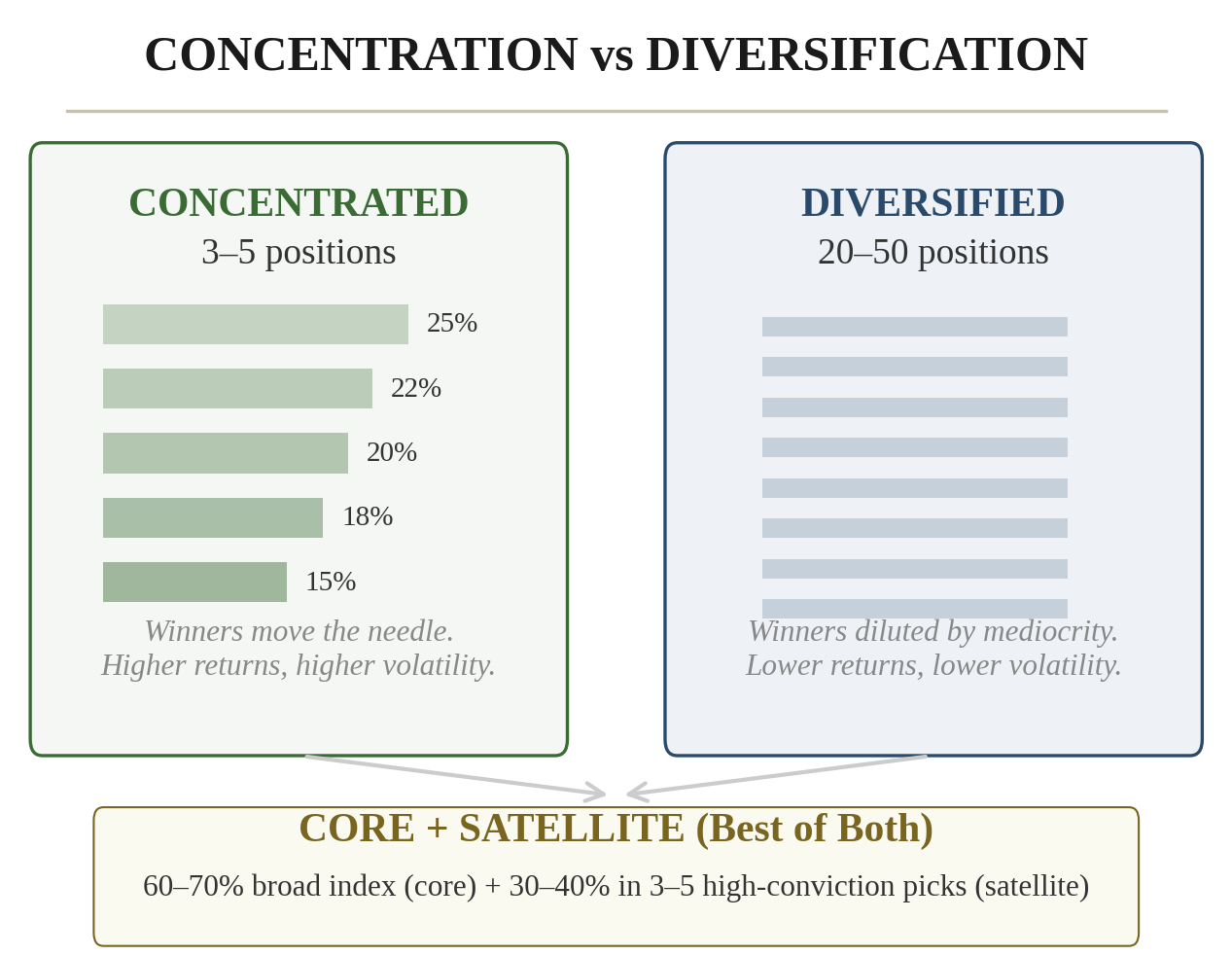
True diversification isn't about counting positions. It's about owning assets that don't all move in the same direction at the same time. The technical term is correlation.
If everything in your portfolio goes up together and down together, you have one bet spread across many names. That's not diversification. That's expensive concentration.
Real diversification means owning assets that respond differently to the same economic conditions. When growth slows and tech stocks suffer, do you also own defensive sectors that benefit? When inflation rises and bonds get crushed, do you have commodity exposure that profits?
This is where the macro regime framework becomes invaluable. Each regime has its winners and losers. A truly diversified portfolio has exposure to assets that perform well in at least two or three different regimes.
The Case for Concentration
Here's the uncomfortable truth: the more you diversify, the closer your returns will track the broad market index. With twenty-five or more stocks, your portfolio becomes a de facto index fund — but one that charges you higher trading costs, more effort, and more tax drag.
If you're going to track the index anyway, just buy the index. It's cheaper, simpler, and tax-efficient. The reason to own individual positions is because you believe specific assets will outperform. And that belief requires concentration to express meaningfully.
Ran two approaches side by side for eighteen months. One portfolio held twelve positions, equally weighted. The other held just four, concentrated in his highest-conviction ideas using the three-pillar framework.
After eighteen months: the twelve-position portfolio returned 14%. The four-position concentrated portfolio returned 31%. The concentrated approach more than doubled the diversified one — because his best ideas were genuinely better than his tenth-best ideas, and concentration let those best ideas matter.
When Concentration Works
When you have genuine, informed conviction. All three pillars aligned: macro theme supports the sector, fundamentals are excellent, price action confirms the uptrend. You've done the work to understand the business.
When you have a small to moderate portfolio. If you're managing £10,000 to £500,000, spreading it across twenty-five positions creates positions too small to matter. A 3% gain on a 4% position is a 0.12% portfolio gain. You'll barely notice it.
When you have the emotional fortitude. A concentrated portfolio will have larger drawdowns. When your largest position — representing 25% of your portfolio — drops 15%, your total portfolio drops 3.75%. If you can't handle that, diversify more.
The Case for Diversification
High conviction, deep knowledge, willing to accept higher volatility. Goal: grow capital as fast as your edge allows. 3–5 positions.
Substantial portfolio built. Primary concern is preservation. Accept lower returns for lower drawdowns and predictable outcomes. 15–30+ positions.
The mistake most people make is diversifying when they should be concentrating (early career, small portfolio, long horizon) and concentrating when they should be diversifying (late career, large portfolio, short horizon).
Three to five high-conviction ideas, leveraged appropriately per the lifecycle framework. Your time horizon and future income make you virtually indestructible over the long term.
Broad diversification across uncorrelated assets — equities across sectors and geographies, bonds of varying duration, some commodity exposure. Stable returns with limited drawdowns through retirement.
Sequence-of-returns risk deserves mention: if you're withdrawing from your portfolio (say, £40,000/year from £1 million), a 30% crash in year one of retirement is catastrophic. Not because of the 30% itself — but because you're forced to sell shares at depressed prices to fund your withdrawals, permanently reducing the base that needs to recover. Diversification protects against this.
The Diversification Trap
Adding positions not because they improve your portfolio, but because it feels safer to have more names. Each new position dilutes the ones you have genuine conviction in.
A trader identifies a genuinely excellent Grade A opportunity. Should make it a 20–25% position. Instead, makes it 5% because they "don't want too many eggs in one basket." Then fills the remaining 95% with positions they only half believe in.
The Grade A position gains 35% over six months. But at 5% weight, that's just 1.75% portfolio impact. Meanwhile, the filler positions average out to roughly flat. The portfolio returns 3–4% in six months when it could have returned 10%+.
Concentration isn't reckless. Reckless is filling your portfolio with positions you don't genuinely believe in because you're afraid of the volatility that comes with conviction.
The Practical Approach
Put 60–70% of your long-term capital in a broad index fund. That's your core. Instant diversification, low cost, market returns as a floor.
Put the remaining 30–40% in three to five high-conviction individual positions using the three-pillar framework. That's your satellite. This is where you generate alpha.
A pragmatic compromise between the mathematical superiority of concentration and the psychological comfort of diversification.
Diversify Across Uncorrelated Opportunities
Whether you hold three positions or thirty, the principle remains: diversify across things that don't move together. If you hold five stocks, don't hold five tech stocks. Hold one tech, one healthcare, one energy, one consumer staple, one international name.
Better yet, diversify across asset classes, not just sectors. A portfolio of three stocks and some gold behaves very differently from a portfolio of four stocks. Gold tends to rise when stocks fall, especially during macro stress that hammers equity portfolios.
Each regime has its best and worst asset classes. A portfolio that holds the best performers from two or three regimes has built-in protection against regime transitions.
You won't maximise returns in any single regime, but you'll avoid catastrophic drawdowns during transitions. And avoiding catastrophic drawdowns is worth more than chasing maximum returns.
The Bottom Line
Concentration builds wealth. Diversification protects it. Neither is always right. The correct approach depends on your portfolio size, time horizon, conviction level, and emotional tolerance for volatility.
If you're young, hungry, and have genuinely informed conviction — concentrate. Three to five positions, backed by the three-pillar framework, sized with courage and managed with discipline. Our verified track record demonstrates what concentrated, conviction-based trading can deliver.
If you've built something worth protecting — diversify. Across uncorrelated assets, across regimes, across geographies. Sleep well. Compound steadily.
And if you're somewhere in between — the core-plus-satellite approach gives you the best of both worlds. Market returns as a floor, concentrated alpha as a ceiling. Explore our market products for the satellite portion of your portfolio.
The goal isn't to be a concentrator or a diversifier. The goal is to be wealthy. Choose the tool that gets you there given where you are right now.
Part Six complete. Next: Part Seven — The Mindset. Your strategy is only as strong as your psychology.
- 1.Concentration builds wealth (3-5 high-conviction positions). Diversification protects it (15-30+ uncorrelated positions).
- 2.Most people diversify when they should concentrate (young, small portfolio) and concentrate when they should diversify (older, large portfolio).
- 3.The core-plus-satellite approach (60-70% index fund + 30-40% concentrated picks) gives the best of both worlds.
This content is for educational purposes only and does not constitute investment advice. Trading and investing involve substantial risk of loss. Past performance is not indicative of future results. Always do your own research and consider seeking professional guidance before making financial decisions.