The best traders are terrible at predicting the future. They're wrong constantly. They misread regimes. They enter too early or too late. They get stopped out on noise. And they still make money — consistently, year after year, decade after decade.
The difference is psychology. Not intelligence. Not information. Not tools. Psychology. Every concept in this book is useless if you can't execute when it matters. And execution, under pressure, with real money at stake, is a psychological skill.
The Three Deadly Mistakes
Mistake 1: No System
Without a repeatable system, every trade is a coin flip with emotion on top. You buy because you "feel good." You sell because you're scared. You hold because you're hoping. And you lose because hope is not a strategy.
Lost £40,000 over fourteen months. Intelligent, well-read, genuinely interested in markets. But he had no system. Every trade was a fresh decision based on whatever he'd read that morning, whatever someone mentioned on a podcast, or whatever chart pattern he thought he'd spotted.
The fix is everything you've learned in this book. The macro regime tells you what. The grade system tells you how much conviction. The trades tell you when. You don't need to be a genius. You need to follow the system.
Mistake 2: No Exit Plan
You entered with a thesis. The entry was fine. But you never decided, before you entered, what would tell you the thesis was wrong. So the stock drops 5%, 10%, 20%, 30%… and you're still holding, anchored to a price that no longer exists.
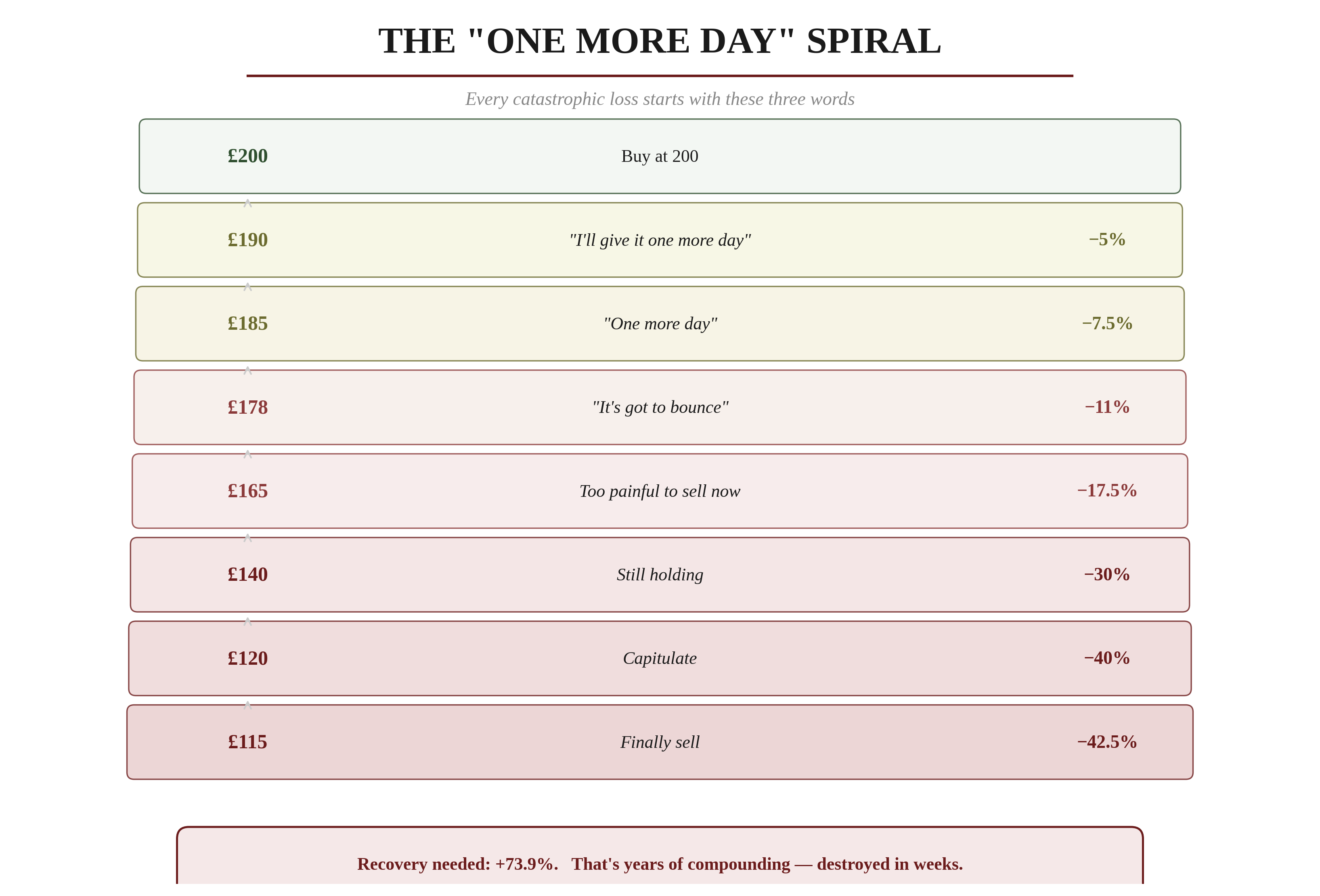
The time to decide when you'll exit is before you enter. Write it down. For Grade A trades, your exit is a trend break or grade downgrade. For everything else, it's a hard stop placed before the trade opens.
Mistake 3: Doubling Down on Losers
"It's even cheaper now!" is one of the most expensive sentences in trading. The stock at £80 is not the same stock you analysed at £100. Something has changed — and the price is telling you before the news does.
Never add to a losing position. If you're wrong, get smaller, not bigger. The only time you add is when the trade is working — when price confirms your thesis and you're building into a winner.
The Emotional Landscape of a Trade
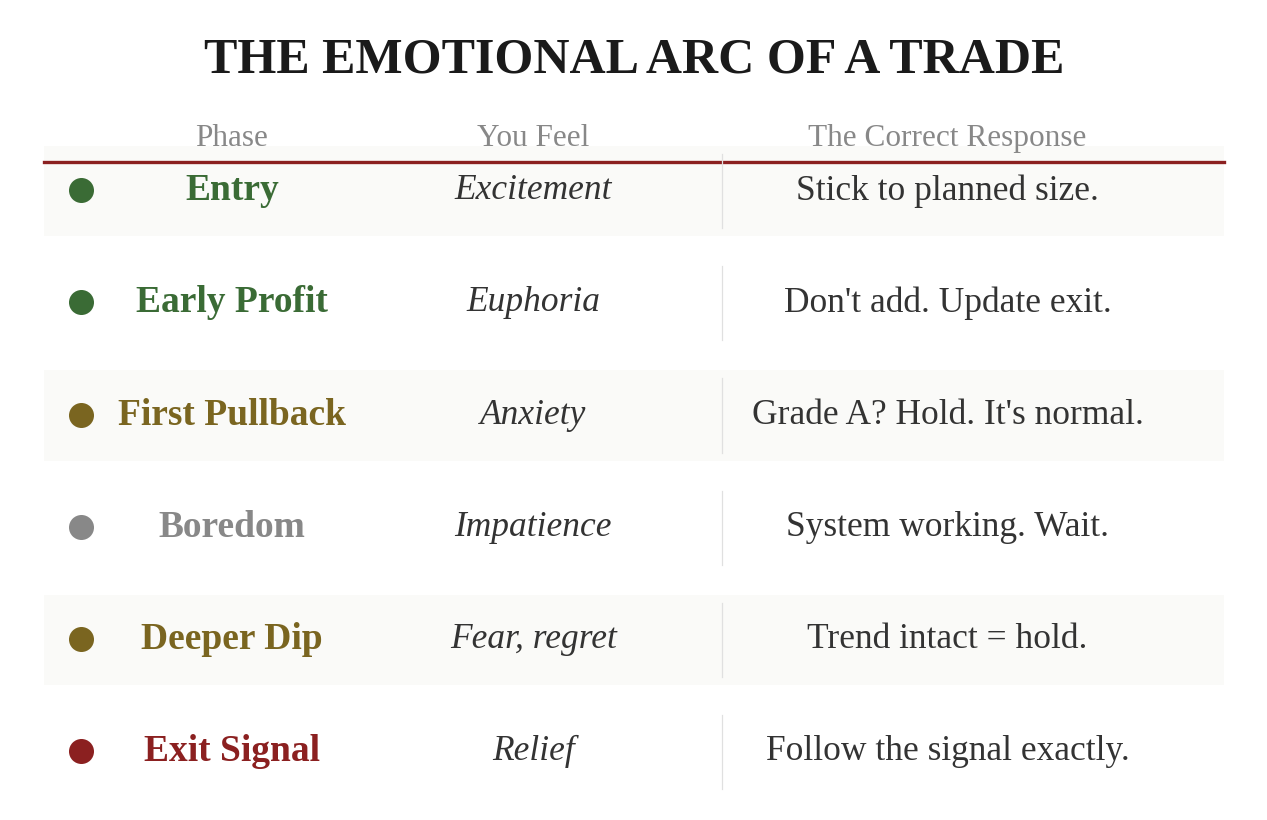
Print that table out. Stick it next to your screen. When you feel the emotion, find yourself in the table, and do what the last column says. Professional traders with decades of experience still use checklists because they know emotion doesn't care how experienced you are.
The Salary Test
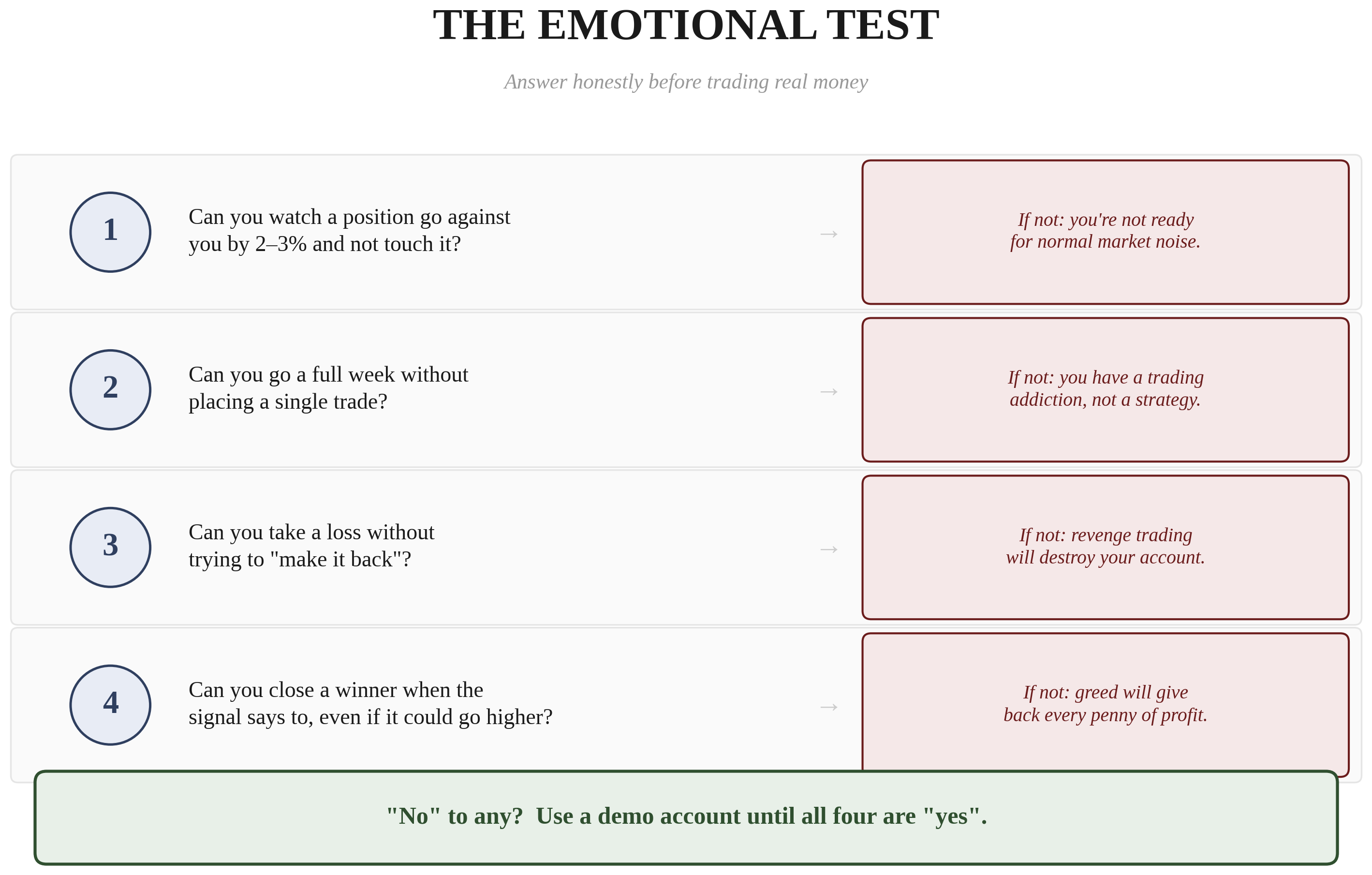
Imagine your monthly salary. Now imagine watching that amount swing back and forth on your screen in a single afternoon. If you can picture that and feel calm — maybe slightly uncomfortable but fundamentally fine — your position size is right. If the thought makes you nauseous, you're too big. Reduce until the swings feel manageable.
If you're going to trade actively, you need to be able to watch your monthly salary fluctuate on screen without making emotional decisions. If you can't, either reduce your size until you can, or redirect your capital to long-term investing. Both are valid. Only one is honest about who you are.
Process Over Outcomes
This is the hardest mental shift in trading, and most people never make it.
Bought a meme stock — no grade, no macro thesis, no signal. It doubled in three days. He posted his gains everywhere. Then did it again. It tripled. Now he was convinced he was a prodigy.
The third meme stock dropped 70% in a week. He held, confident it would bounce. It didn't. He added. It dropped further. By the time he finally sold, he'd lost everything he'd made plus his original capital. Two months of lucky outcomes followed by one honest outcome wiped him out.
Judge your decisions by the quality of the process, not the outcome.
A Grade A trade that follows every rule and still loses is a good decision. A random punt that makes money is a bad decision. If you can't make that distinction, every winning trade reinforces bad habits and every losing trade shakes your confidence in good ones. To study this framework at your own pace, download the complete book as a free PDF.
The Revenge Trade
You just lost money. Your ego is bruised. You want to "make it back." So you scan for the next setup — not because a Grade A opportunity has appeared, but because you're angry and impatient. You enter something borderline. You size up because you need a bigger win to recover. It goes against you.
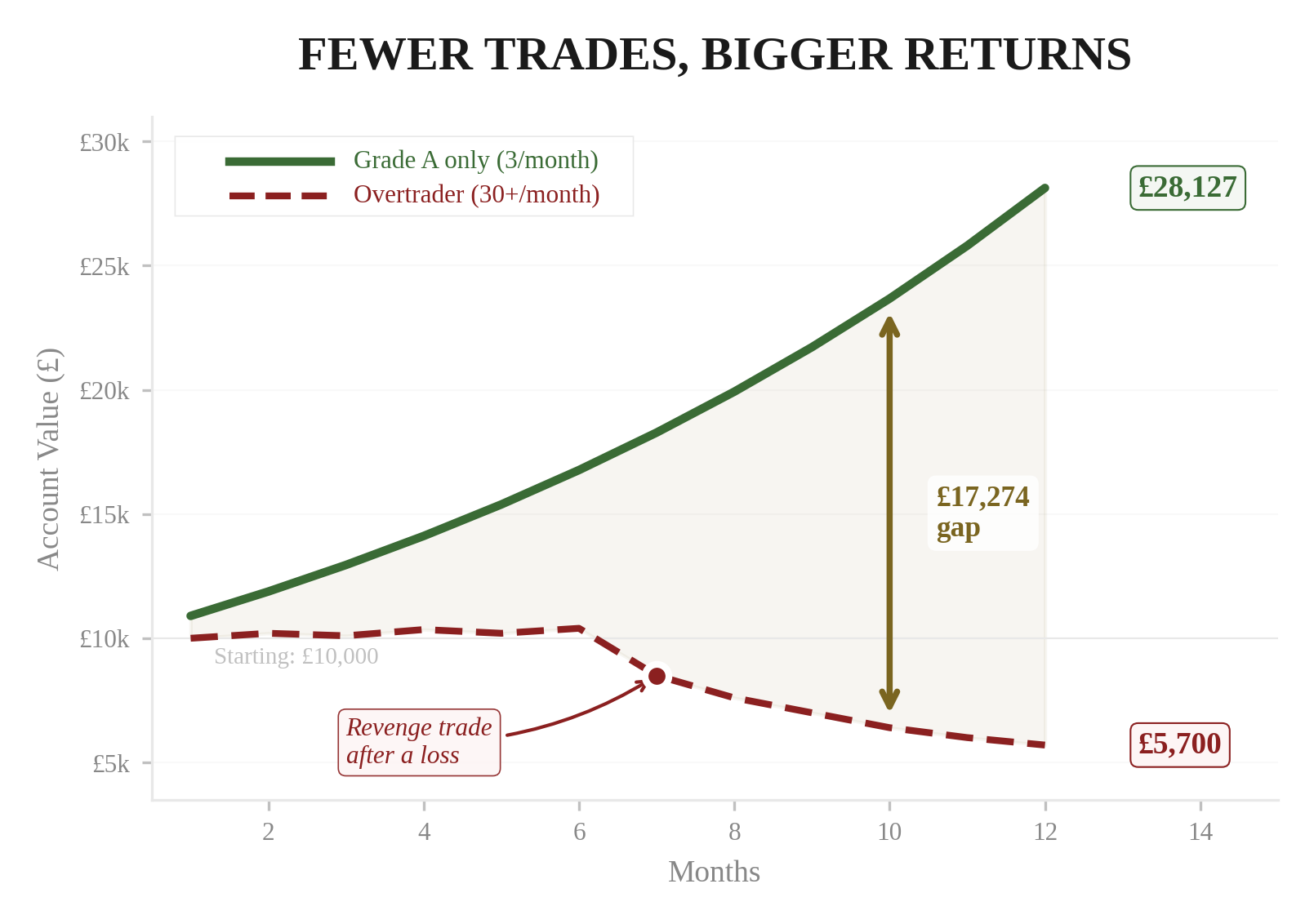
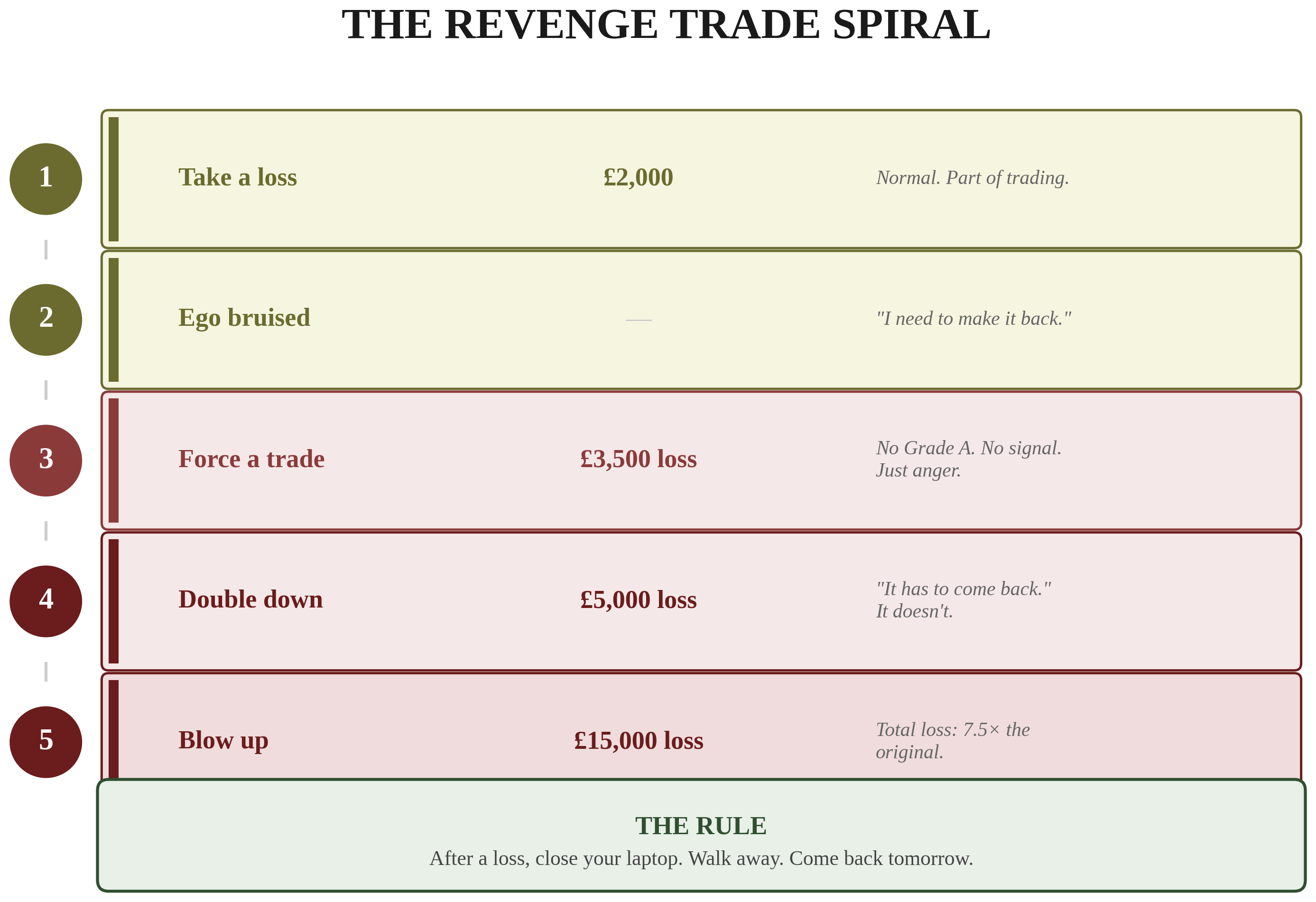
After a loss, walk away for 24 hours. Don't look at screens. Don't scan for trades. Don't touch your account. Come back tomorrow with fresh eyes and wait for the next Grade A.
The market will be there. It's been there every day for centuries. It'll be there tomorrow.
The Journal
The single most powerful tool for improving your trading psychology isn't a book, a course, or a mentor. It's a journal.
After every trade — win or loss — write down four things:
What was the setup? Grade, macro regime, signal, entry, planned exit.
What did I feel? Before entry, during the trade, at exit. Be brutally honest.
Did I follow my rules? Yes or no. If no, what did I do differently and why?
What would I do differently? Not about the outcome. About the process.
Do this for three months. Then read back through your journal. You will see patterns you never noticed in real time. You'll discover that most of your losses came from the same mistake repeated. The journal turns invisible patterns into visible data.
One trader reviewed three months of journal entries and found something she'd never noticed in real time: every single one of her losing trades had been entered within 30 minutes of reading financial news. Every one. Her winners were all entered from her morning setup sheet before checking the news.
She stopped reading news before placing orders. Her win rate improved from 52% to 64% in the following quarter. The journal found the pattern. The discipline fixed it.
The Identity Trap
The most dangerous psychological trap has nothing to do with any individual trade. It's when your identity becomes wrapped up in being "a trader."
When you identify as a trader, losses feel like personal failures. Missing a move feels like a moral shortcoming. And worst of all, you start taking trades you shouldn't, because "a trader" needs to be trading.
You are not your trades. You are a person who uses a process to allocate capital. Sometimes the process says act. Sometimes it says wait. Both are part of the job.
If you find that not trading for a week makes you anxious, that's worth examining. The market doesn't owe you a trade every week.
What the Best Traders Look Like
They're calm. Almost boringly calm. A winning trade gets the same reaction as a losing one: "Did I follow my process? Yes. Good. What's next." They've trained themselves into emotional flatness over years of practice and journaling.
They trade infrequently. Most weeks, they do nothing. They're scanning for Grade A trades and finding none, and they're perfectly content with that. When they do trade, the sizing is deliberate and the exit is pre-defined. If you want to experience this process, start a free 7-day trial.
They're humble. Every single one has a story about a time they deviated from their process and got destroyed. They carry that scar not as shame but as inoculation.
They have other interests. The less your identity depends on trading, the better you trade. The person who can walk away from the screen without anxiety can hold through a drawdown that would break someone whose entire self-worth is tied to the P&L.
The next chapter covers the practical side of the business — taxes, account structures, and the administrative foundations that professional traders build to protect their gains.
- 1.The three deadly mistakes: no system, no exit plan, and doubling down on losers. Written rules override emotional impulses.
- 2.Process over outcomes — a losing Grade A trade is a good decision; a winning random punt is a bad decision.
- 3.After any loss, walk away for 24 hours. The revenge trade is the single fastest way to turn a small loss into a catastrophic one.
This content is for educational purposes only and does not constitute investment advice. Trading and investing involve substantial risk of loss. Past performance is not indicative of future results. Always do your own research and consider seeking professional guidance before making financial decisions.