A well-known investment bank published a report telling clients that a major financial institution was "well-capitalised" and a strong buy at $67 per share. Their analysts had done months of research. They'd built detailed models, met with management, reviewed every quarterly filing. Their conviction was absolute.
Meanwhile, the stock's price had been making lower highs for six months straight. It had broken below its 200-day moving average. Volume was spiking on down days. The price was screaming that something was wrong.
Within 18 months: trading at $2The analysts' models were worthless. Their management meetings were worthless. Their quarterly filings were worthless. Everything they'd relied on told them the company was fine. The only thing that told the truth was the price.
This chapter is about the single most important principle in this entire book: price is the ultimate truth in markets. Everything else is opinion.
Why Opinions Don't Matter
Markets are full of opinions. Analysts have opinions. Fund managers have opinions. CEOs have opinions about their own companies. Financial TV has opinions twenty-four hours a day, seven days a week. Your uncle has opinions.
And almost none of these opinions consistently predict what an asset will do next.
Consider what an opinion is. It's someone's interpretation of information that is already public. The earnings report everyone read. The GDP number everyone saw. The interest rate decision everyone heard. By the time someone forms an opinion and shares it with you, the market has already priced it in.
The market takes every piece of publicly available information — plus a mountain of private information you'll never have access to — and distils it all into a single number: the price.
That price is the collective wisdom of every buyer and seller on the planet, weighted by the amount of money they're willing to risk on their conviction. It's the most democratic, most information-rich signal in all of finance.
When a CNBC analyst tells you a stock is a buy, they're giving you their interpretation of information the market already knows. When the stock's price is falling, the market — with access to far more information than any single analyst — is telling you the opposite.
Interpretation of public information. No skin in the game. No accountability.
Every buyer and seller on Earth, weighted by conviction. Real capital at risk.
Who do you trust? The person talking, or the people putting real money on the line?
The Media Trap
Financial media exists to do one thing: keep you watching. That's it. Their business model is attention, not accuracy. They are paid by advertisers to keep your eyeballs on the screen. Every "BREAKING NEWS" banner, every dramatic prediction, every heated debate between pundits — it's all designed to keep you engaged, not to make you money.
The incentive structure is completely misaligned with your interests as a trader or investor. A calm, measured analyst who says "I don't know what will happen next" doesn't get invited back on television. The one who pounds the table and makes a bold prediction does — regardless of whether they're right or wrong.
Nobody tracks whether these predictions are right. There's no scoreboard. An analyst can make 50 wrong predictions in a row and still appear on TV every week with the same confident tone.
There is no accountability in financial media. Zero. If a doctor was wrong 50 times in a row, they'd lose their licence. If a pilot was wrong 50 times, they'd be grounded. Financial commentators? They get a bigger contract. That's precisely why we publish our verified track record — full transparency, no hiding from results.
Now compare that to price. Price is accountable every second of every trading day. It can't lie. It can't spin. It can't have a bad take that it quietly walks back next week. Price is the only honest voice in a room full of salespeople.
Fundamentals Are Backwards-Looking
This next idea will upset people who love fundamental analysis, but it needs to be said: by the time fundamental data reaches you, it's already old.
An earnings report tells you what happened last quarter. Not what's happening right now. Not what will happen next quarter. What already happened. You're making decisions based on a rearview mirror.
Revenue, profit margins, debt levels, management guidance — all of it describes the past. The market doesn't pay you for understanding the past. It pays you for positioning correctly for the future.
Every fundamental metric for the airline industry was healthy. Revenue was at record levels. Planes were full. Balance sheets were solid. If you were a fundamental analyst, you would have been extremely bullish on airlines in January 2020.
Two months later, airline stocks lost 60–80% of their value.
The fundamentals were flawless. The price didn't care about the fundamentals. It cared about what was coming next.
Fundamental analysis: flawless. Result: catastrophic.Price moves first. Always. Insiders, institutions, and algorithmic systems act on information before it becomes public. By the time it shows up in an earnings report or a news headline, the smart money has already moved. The price has already adjusted. You're looking at a photograph of something that has already changed.
The Price Tells You What Matters
Every piece of relevant information about an asset — earnings, macro conditions, insider activity, fund flows, algorithmic signals, geopolitical risk, sentiment, positioning — is reflected in one place: the price.
You don't need to understand why a stock is going up. You need to recognise that it is going up, and position yourself accordingly. The "why" will become clear later. By then, the move is usually over.
Gold started moving higher despite every analyst on television saying it shouldn't be. "Real yields are high," they said. "The dollar is strong. Gold should be falling." They had great arguments. The price disagreed.
Gold gained over 30% in the following twelve months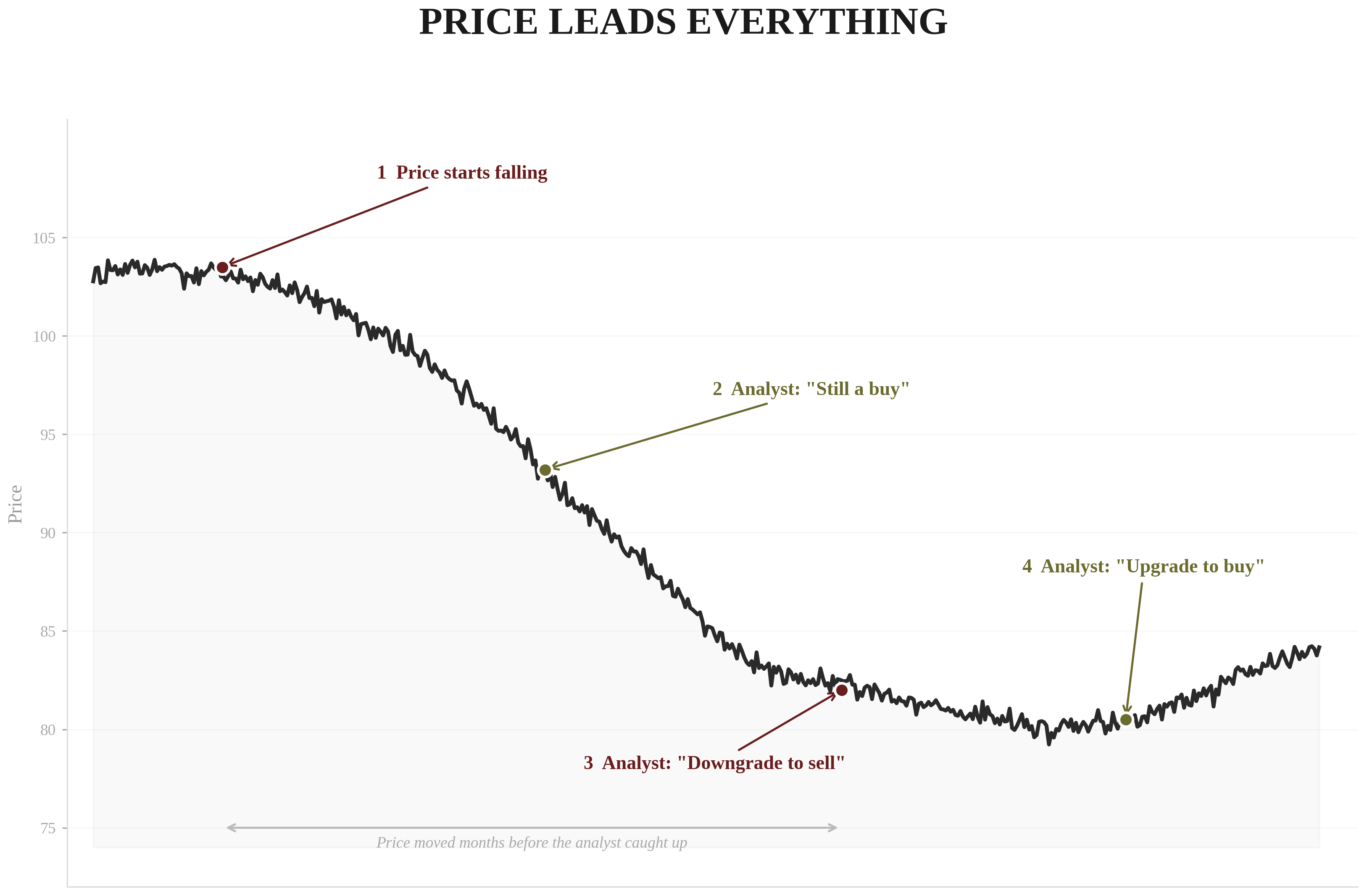
The lesson: price doesn't need your permission to move. It doesn't wait for you to understand the narrative. It moves, and your job is to follow it.
How This Connects to the Grading System
Now you can see why the grading system from Part One requires both a mathematical signal (based on price) and a macro direction. The price gives you timing and confirmation. The macro gives you context and direction.
If you had to choose only one — if you could only follow price or only follow fundamentals — take price every single time.
A stock with great fundamentals and falling prices will lose you money. A stock with questionable fundamentals and rising prices will make you money. The price is the final arbiter.
This principle should guide every trading decision you make from this point forward. When you're conflicted about a trade, when analysts are saying one thing and the chart is saying another, when the news sounds terrifying but the price is holding steady — trust the price. It knows something you don't. Our market products are built on this exact principle — price leads everything.
Price is the only honest voice in a room full of salespeople.
With this foundation in place — that price leads everything — the next chapter covers the technical tools that help you read what the price is telling you.
- 1.Price is the ultimate truth in markets — it reflects all known information plus insider knowledge you'll never have.
- 2.Financial media is designed to keep you watching, not to make you money. Trust the chart over the commentary.
- 3.When analysts say one thing and the price says another, trust the price. It always moves first.
This content is for educational purposes only and does not constitute investment advice. Trading and investing involve substantial risk of loss. Past performance is not indicative of future results. Always do your own research and consider seeking professional guidance before making financial decisions.