Before we go any further, we need to have an uncomfortable conversation.
If you're going to beat those odds, you need to understand exactly why so many people fail. Because the reasons aren't what most people think.
Reason 1: Overtrading
The number one killer. It's not even close.
Overtrading is taking too many positions, too frequently, with too little conviction behind each one. It comes from boredom, from the fear of missing out, from the mistaken belief that more activity equals more profit.
Here's what overtrading looks like. A trader wakes up and checks their screen. Nothing meets their criteria, but they're "feeling good" about the market today. They take a trade anyway. It loses 1%. No big deal. An hour later, they take another trade to make back the loss. It also loses. Now they're down 2% and frustrated. They take a third trade, bigger this time, because they need to get back to even. It loses too. By lunchtime they're down 4% and their day is ruined.
That 4% day took weeks to earn back. And they'll do the same thing next week. And the week after. By the end of the month, they've made 60 trades, paid commission on all of them, and their account is smaller than when they started. But they felt busy. They felt like they were "working hard." In trading, working hard is not a virtue. Working smart is.
Remember the math from Chapter 3: three Grade A trades per month at 3% each is 9% per month. That same trader who took 30 mediocre trades in a month probably lost money on the aggregate — even if their win rate on individual trades was 50%. Because mediocre trades have thin margins, high commissions, and emotional baggage that compounds with every loss.
The solution is simple but painful: trade less. Much less. Only take Grade A trades. If that means you go a week without trading, that's a good week. You didn't lose money.
Reason 2: The Win Rate Myth
Most people think good trading means having a high win rate. Win 70% of your trades and you'll be profitable, right?
Wrong. Spectacularly wrong.
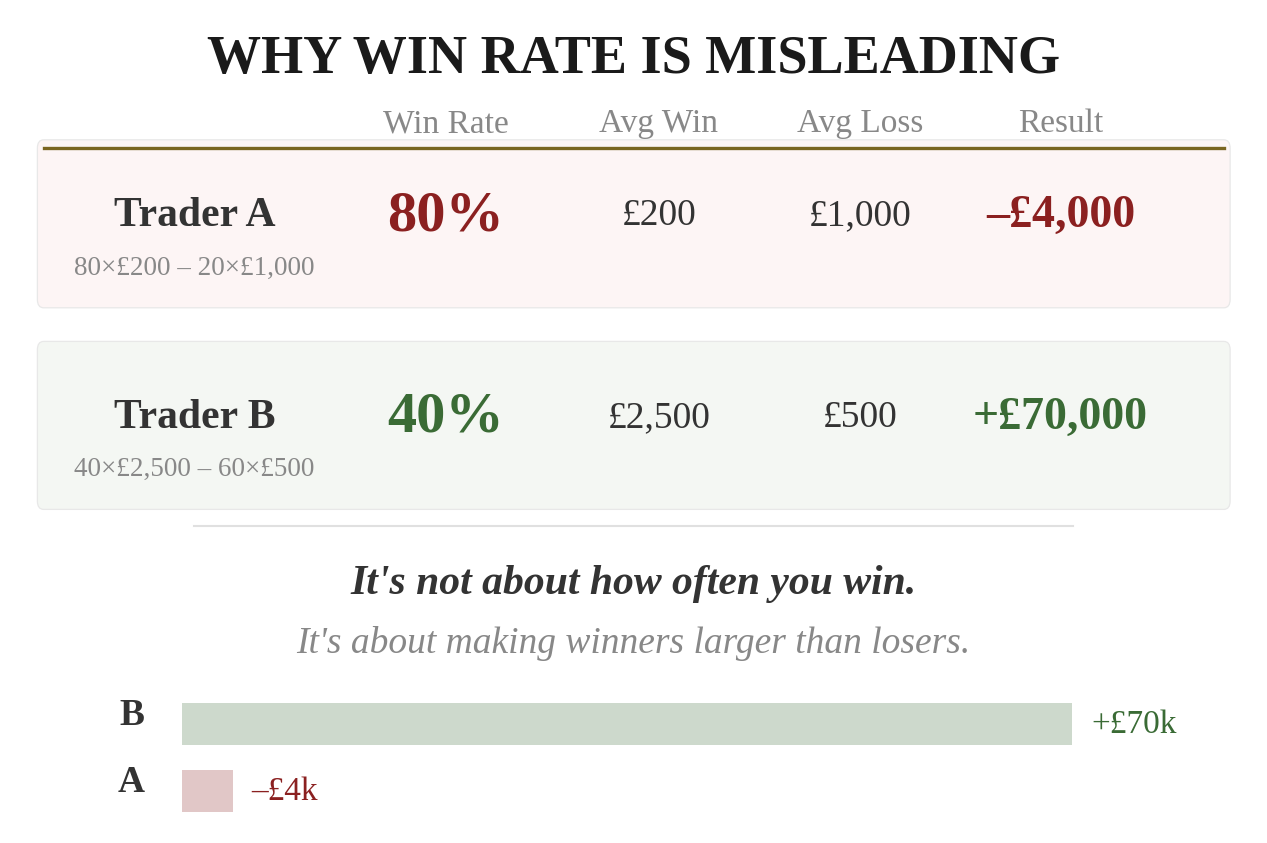
A trader who wins 80% of the time can still go broke. And a trader who wins only 40% of the time can still get very wealthy. The win rate tells you almost nothing about profitability. What matters is the relationship between how much you win when you're right and how much you lose when you're wrong.
Consider Trader A: wins 80% of the time, average win is £200, average loss is £1,000. Over 100 trades: 80 wins × £200 = £16,000 in gains. 20 losses × £1,000 = £20,000 in losses. Net result: −£4,000. Despite winning 80% of the time, they're broke.
Now consider Trader B: wins only 40% of the time, average win is £2,500, average loss is £500. Over 100 trades: 40 wins × £2,500 = £100,000 in gains. 60 losses × £500 = £30,000 in losses. Net result: +£70,000. Despite losing more often than winning.
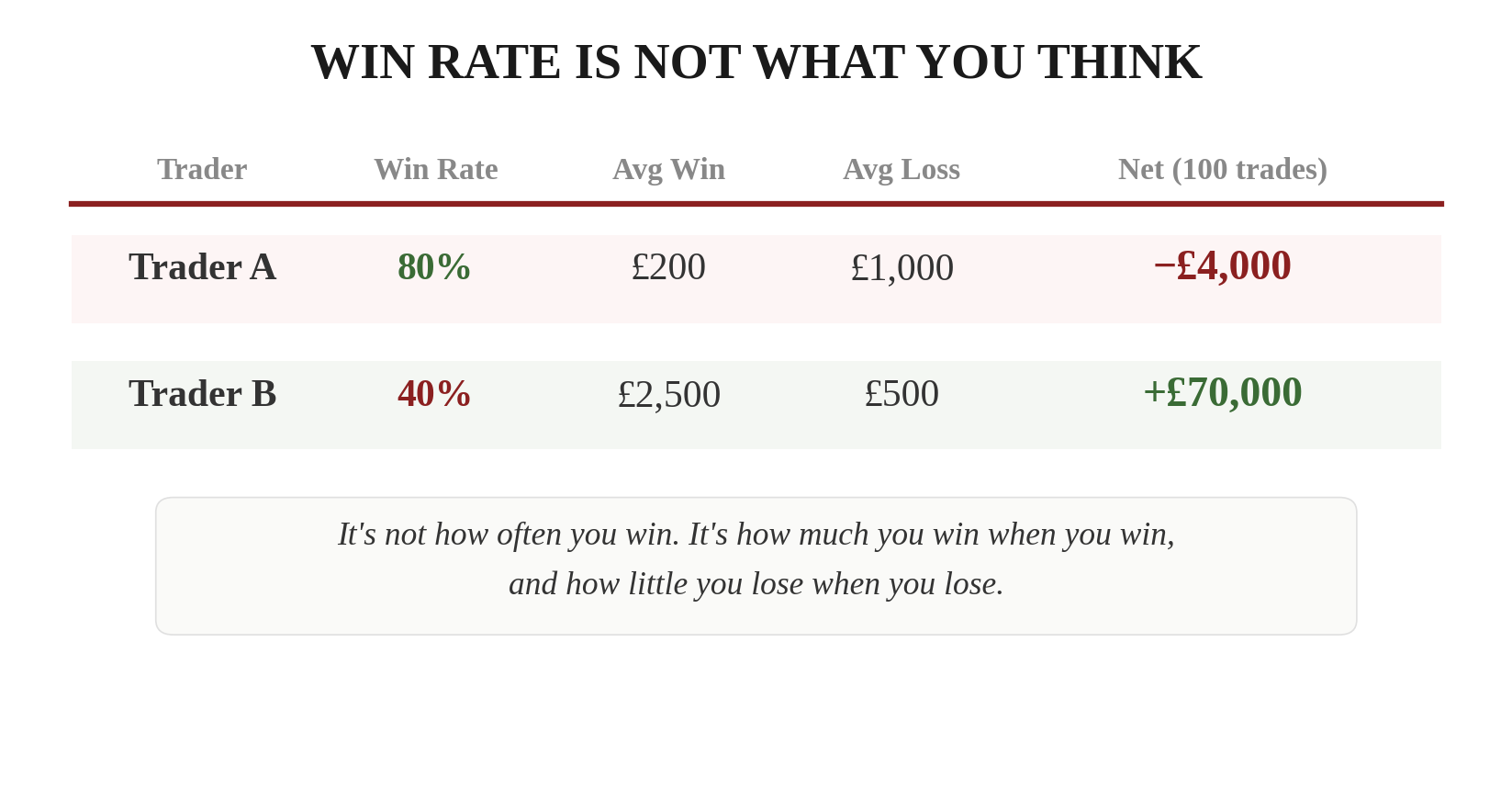
It's not about how often you win. It's about making your winners significantly larger than your losers. This is why Grade A trades — where you hold with conviction, add on dips, and let the trade run — are so powerful. Your winners become multiples of your losers.
Reason 3: Prop Firms and the Illusion of Free Money
This one needs to be said clearly because it's become an epidemic, especially among newer traders.
Proprietary trading firms — "prop firms" — offer you funded accounts. The pitch sounds exceptional: pass our evaluation, and we'll give you $100,000 (or $200,000, or $500,000) to trade with. Keep 80% of the profits. Risk none of your own money.
It sounds like the ultimate shortcut. Trade with someone else's money, keep most of the gains, risk nothing.
The reality is very different.
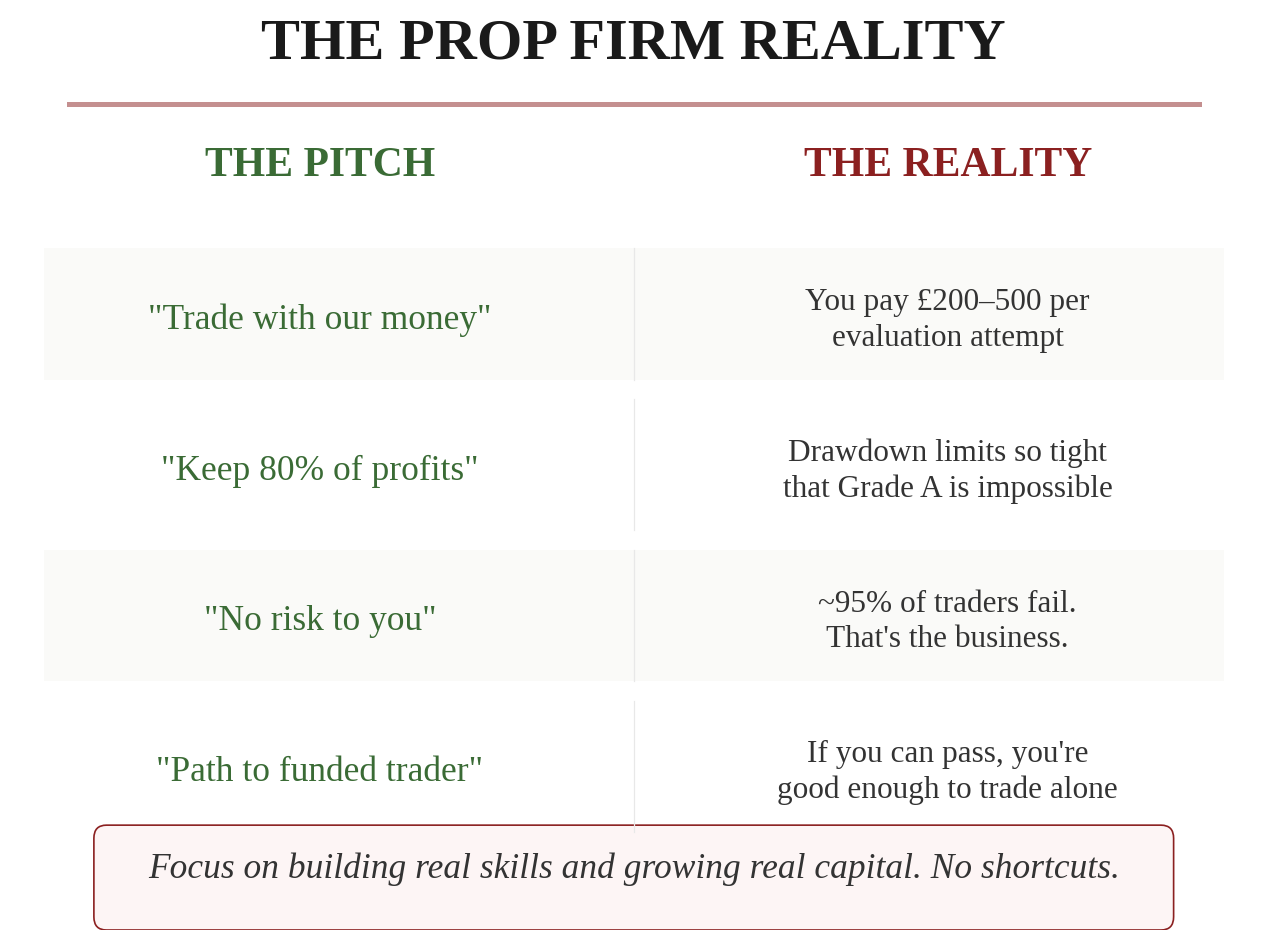
First, the evaluation itself is designed to fail you. The drawdown limits are extremely tight — often 5–10% maximum, which in volatile markets can get hit on a perfectly valid trade. You pay a fee to take the evaluation. When you fail, you pay again. And again. The prop firm's real business isn't funding traders — it's collecting evaluation fees from traders who fail.
Second, even if you pass, the rules of the funded account are structured to prevent you from trading the way successful traders trade. Tight daily loss limits. Restrictions on holding overnight. No news trading. Position size caps. These rules eliminate the very strategies that would make you profitable.
If you're good enough to consistently pass prop firm evaluations and trade profitably within their constraints, you're good enough to trade your own money. A £5,000 account traded well, with proper risk management and Grade A discipline, will grow faster and more sustainably than chasing prop firm evaluations.
Prop firms are a distraction. Focus on building real skills and growing real capital. There are no shortcuts worth taking.
Reason 4: Emotional Decision-Making
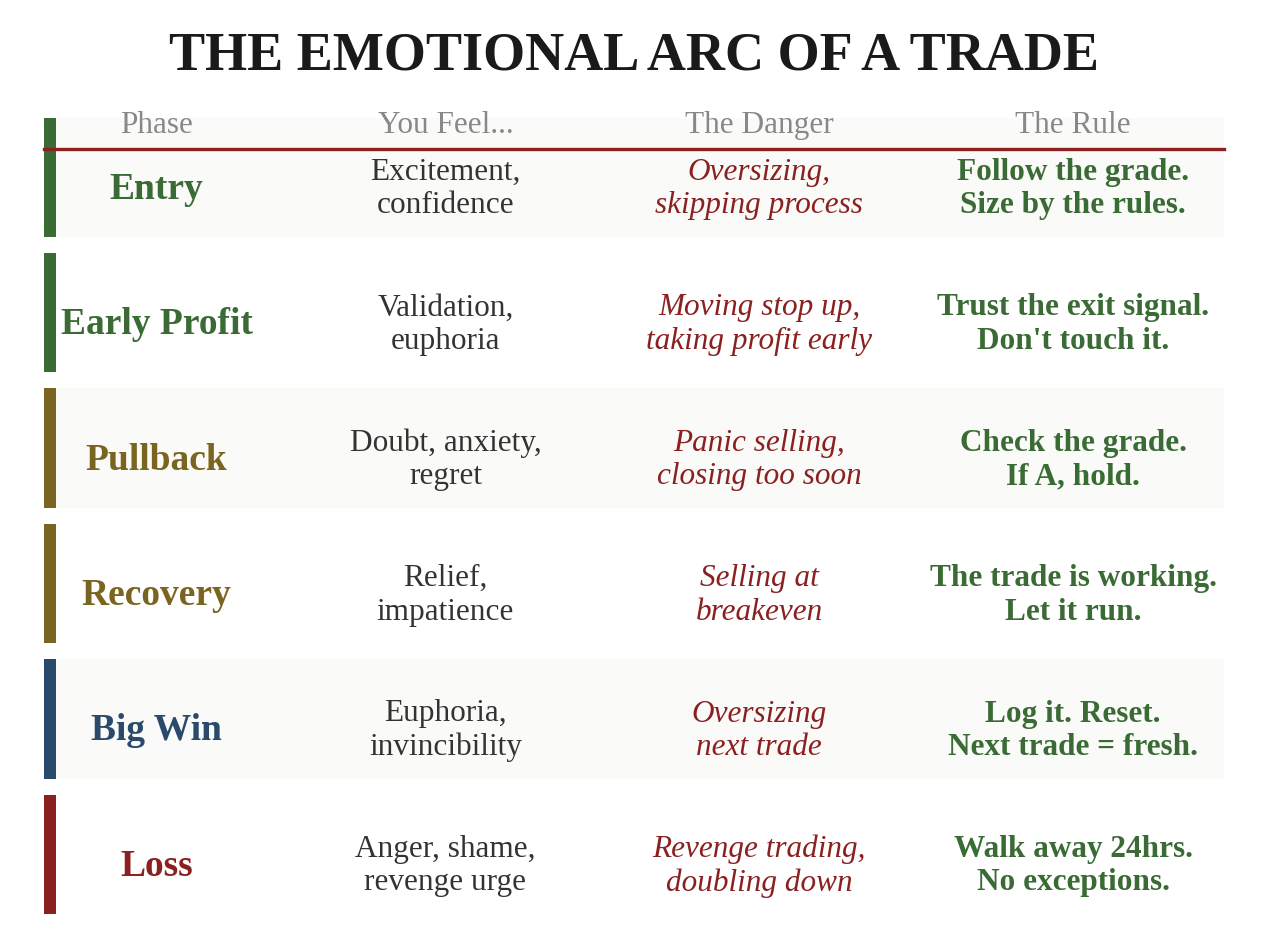
Markets have a supernatural ability to find your emotional weak spots and exploit them. Every trader has a breaking point, and the market will find it — usually at the worst possible moment.
You've done everything right. The macro supports your trade. The setup confirmed. Grade A. You bought at 178, exit at 190. The stock dips to 175. Then 173. Then 171. Every fibre of your being screams: "Sell. Get out."
You sell at 171. The stock bottoms at 170.50, reverses, and hits 192 within two weeks. Your Grade A trade would have made you 7%. Instead, you lost 4%.
Fear doesn't protect you. Fear makes you crystallise temporary drawdowns into permanent losses.
You're in a beautiful trade. Bought at 150, now at 168. Exit signal says 170. But the stock is running. The momentum feels unstoppable. "Why sell at 170? This could go to 180. Maybe 200."
You ignore the exit signal. The stock hits 172, reverses. 168. 165. 160. You're still holding. It falls to 153. Your 12% gain has turned into a 2% gain. The setup said sell. You should have sold.
You've spent hours analysing a trade. You've told your friends about it. Maybe you posted about it online. You're convinced this stock is going higher. Then the price starts going lower. And lower.
A trader without ego takes the loss at 2% and moves on. A trader with ego holds. "The market is wrong. I've done the research." No, you haven't done more research than the entire market. You are one person with a laptop. Act accordingly.
The most dangerous of all. You've just taken a loss. You're angry, frustrated, and you want your money back. So you take the next trade you see — no analysis, no grading, no macro check. You need to win one.
This is no longer trading. This is gambling. And when you're gambling with a wounded ego, you size up. You take more risk. One revenge trade can do more damage than the original loss that triggered it.
The antidote: if you take a loss, close your laptop. Walk away. Come back tomorrow. The market will still be there.
The Emotional Test
Before you trade with real money, answer these questions honestly:
Can you watch a position go against you by 2–3% and not touch it? If you can't sit through a normal pullback, you're not ready for real money. Every trade has drawdowns. If a 2% dip sends you into panic mode, you'll cut every winner short.
Can you go a full week without trading? If the absence of activity makes you anxious, you have a trading addiction, not a trading strategy. The market doesn't owe you a trade every day.
Can you take a loss without immediately trying to "make it back"? If your first instinct after a losing trade is to jump back in bigger, you are going to blow up your account. It's not a matter of if. It's when.
Can you close a winning trade when the trade says to, even if you think it could go higher? Greed kills more traders than fear does. The setup says take profit. You take profit. Full stop.
If you answered no to any of these, trade on a demo account until you can answer yes to all four. There is no shame in this. In fact, it's the smartest thing you can do. Demo trading costs you nothing. Real trading with the wrong mindset costs you everything.
The Real Reason People Lose
Underneath all of these reasons — overtrading, chasing win rates, prop firm illusions, emotional decisions — there's one root cause: the absence of a system.
People lose money in markets because they're making it up as they go. They don't have defined entry criteria. They don't have a grading framework. They don't know which macro regime they're in. They don't have exit rules written down before the trade starts. Every decision is improvised, emotional, and reactive. Our market products were designed to solve this exact problem — predefined entries, exits, and grades across six markets.
The grading system, the macro framework, the execution process — all of it exists to replace improvisation with structure. When you have a system, every decision is pre-made. If you'd like to see what a fully systematic approach looks like, you can try it free for 7 days.
You don't have to wonder whether to hold or sell when a trade dips — the grade tells you. You don't have to guess whether to enter — the trade tells you. You don't have to feel anxious about which assets to trade — the macro tells you.
A system doesn't eliminate losses. Nothing eliminates losses. But a system makes losses small, controlled, and expected. And it makes wins large, sustained, and repeatable. Over time, that's the only thing that matters.
Now that we understand why most people fail, the next chapter focuses on building the specific habits and routines that keep you on the right side of the statistics.
- 1.Overtrading is the #1 killer — more activity does not equal more profit.
- 2.Win rate is misleading — a 40% win rate with large winners beats an 80% win rate with small winners.
- 3.The absence of a system is the root cause of all trading failure. Replace improvisation with structure.
This content is for educational purposes only and does not constitute investment advice. Trading and investing involve substantial risk of loss. Past performance is not indicative of future results. Always do your own research and consider seeking professional guidance before making financial decisions.