There's a reason your grandad's trading advice doesn't work anymore.
Twenty years ago, a smart retail trader with a newspaper and a phone could compete. They could read an annual report, form a view on a company, call their broker, and buy shares. The information advantage was about who did the best homework. A diligent individual could genuinely outperform by reading more carefully than the next person.
That world is gone. And if you're still trying to trade like it exists, you're bringing a knife to a gunfight.
The Machine
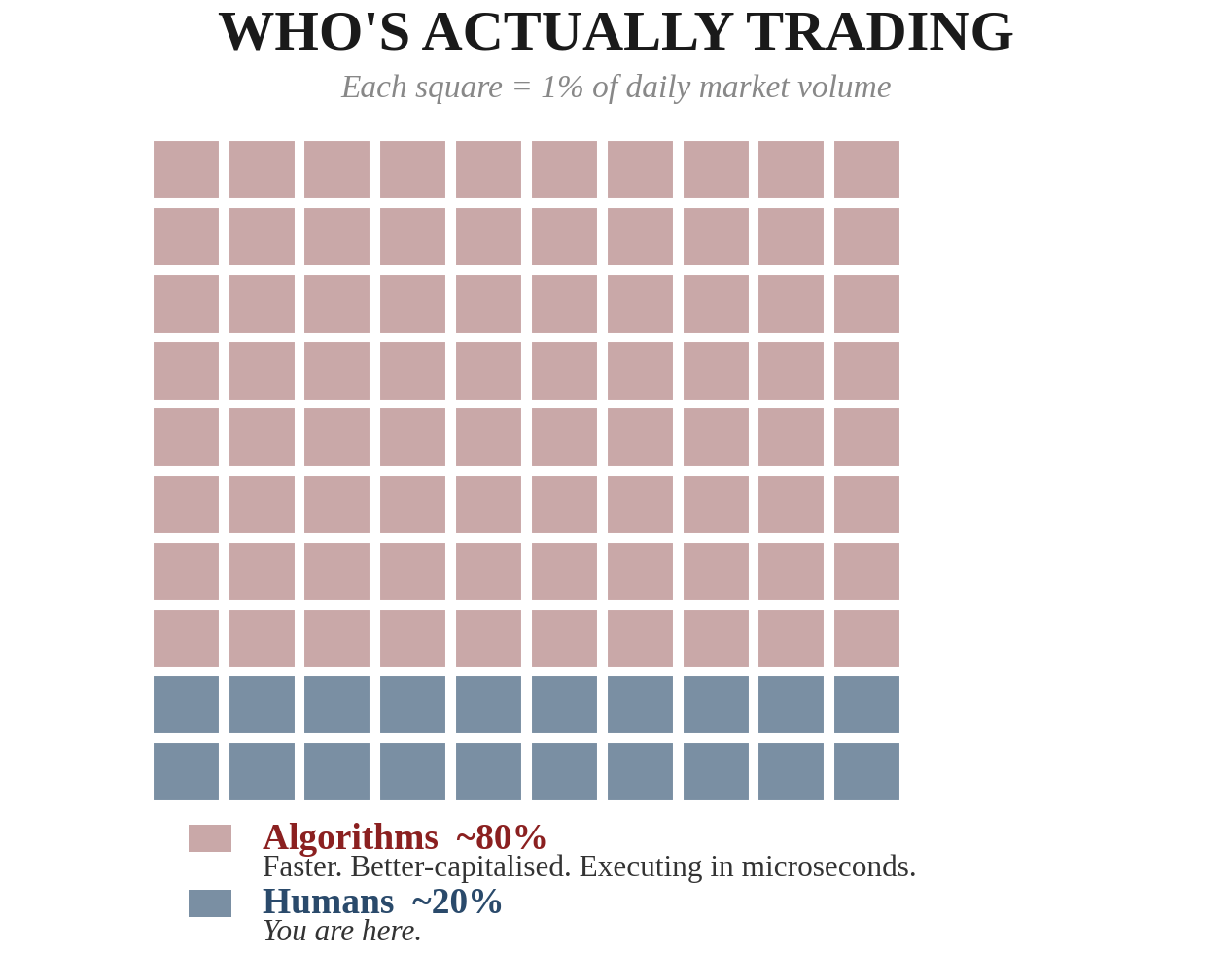
These aren't simple programs. They're sophisticated systems running on servers co-located inside the exchange itself, physically positioned metres from the matching engine to shave microseconds off execution time. They're analysing price, volume, order flow, news headlines, social media sentiment, satellite imagery, and hundreds of other data sources simultaneously.
Here's what this looks like from your end. You decide to buy 200 shares of a stock trading at 150.00. You open your broker app, type in the order, and hit "buy." Between the moment you press that button and the moment your order reaches the exchange — maybe 50 milliseconds — an algorithm has already detected the incoming buy pressure, bought ahead of you, and is now selling to you at a slightly higher price.
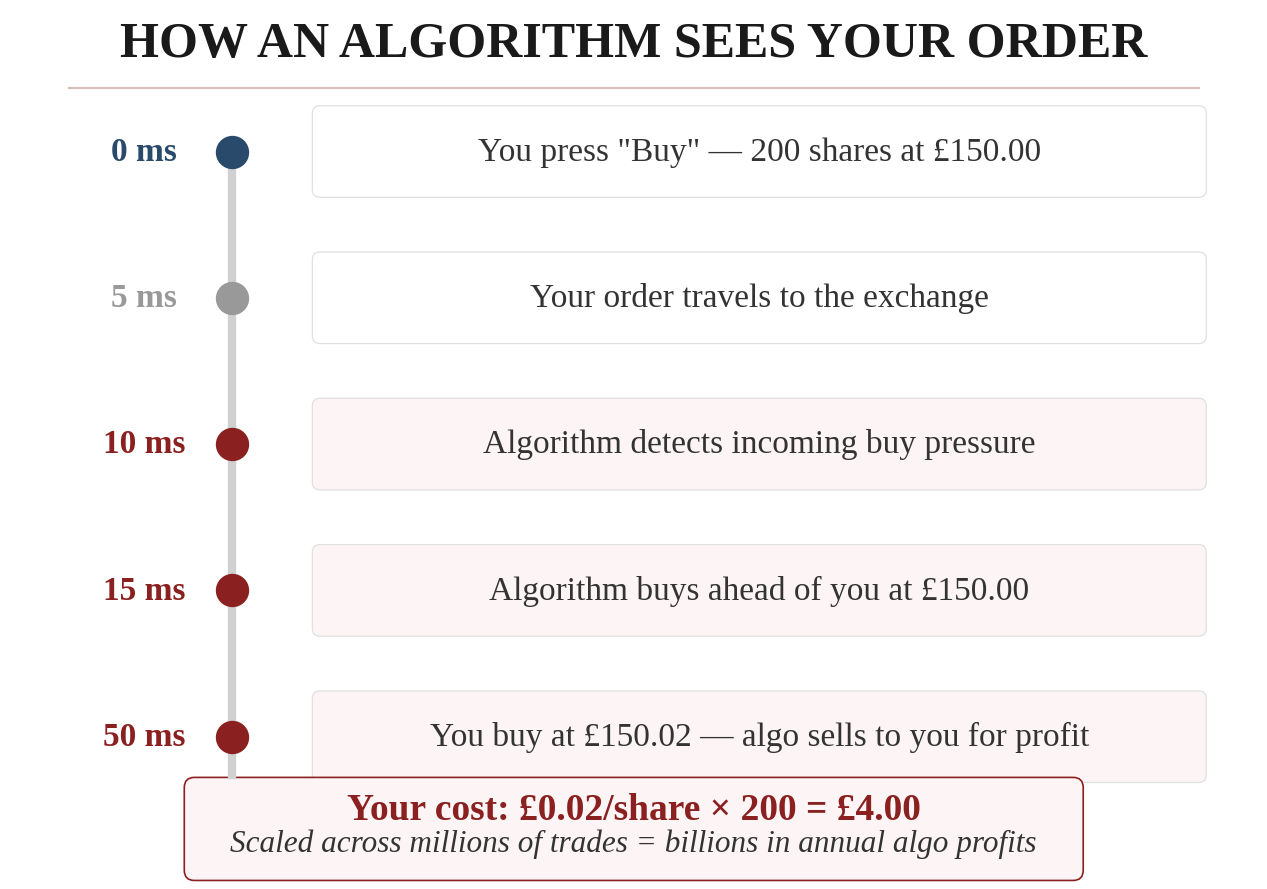
This is not conspiracy theory. This is documented, regulated, publicly known market structure. It's how modern markets work. And it's why trying to compete with these machines on speed is a guaranteed losing proposition.
What This Means for You
If most volume is algorithmic, and these algorithms are faster, better-informed, and better-capitalised than you — how can you possibly compete?
The answer is: you don't compete on their terms. You compete on different terms entirely.
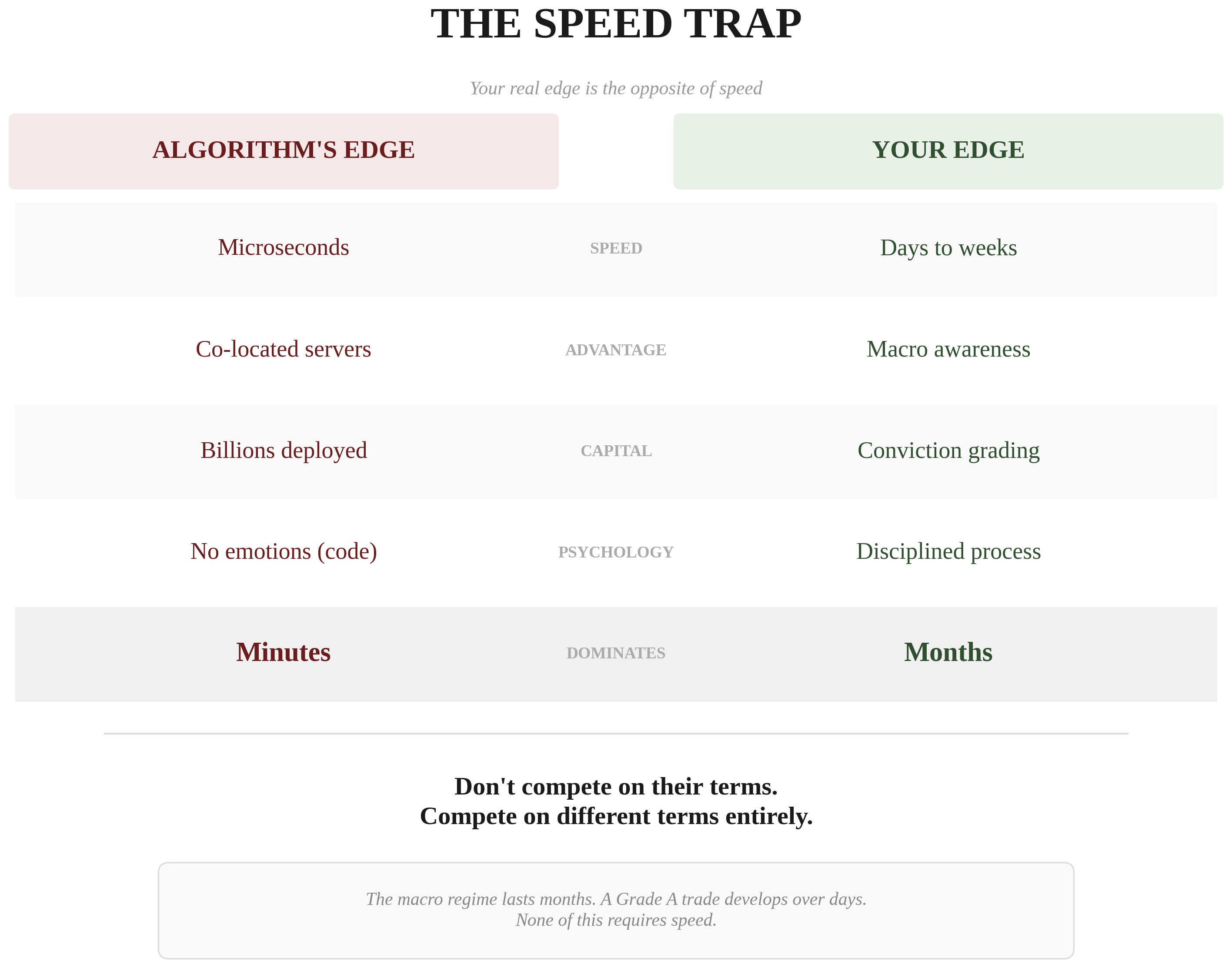
Algorithms are exceptional at short-term price discovery. They dominate microsecond-to-minute timeframes. They're optimised for speed and liquidity. But they have blind spots. They can't understand macro regimes. They can't judge whether an economic cycle is turning. They can't hold a position for three weeks because the conviction grade says A.
The algorithms are the ocean current. You are the sailor. You can't fight the current, but you can read it and use it to get where you want to go.
The ETF Revolution
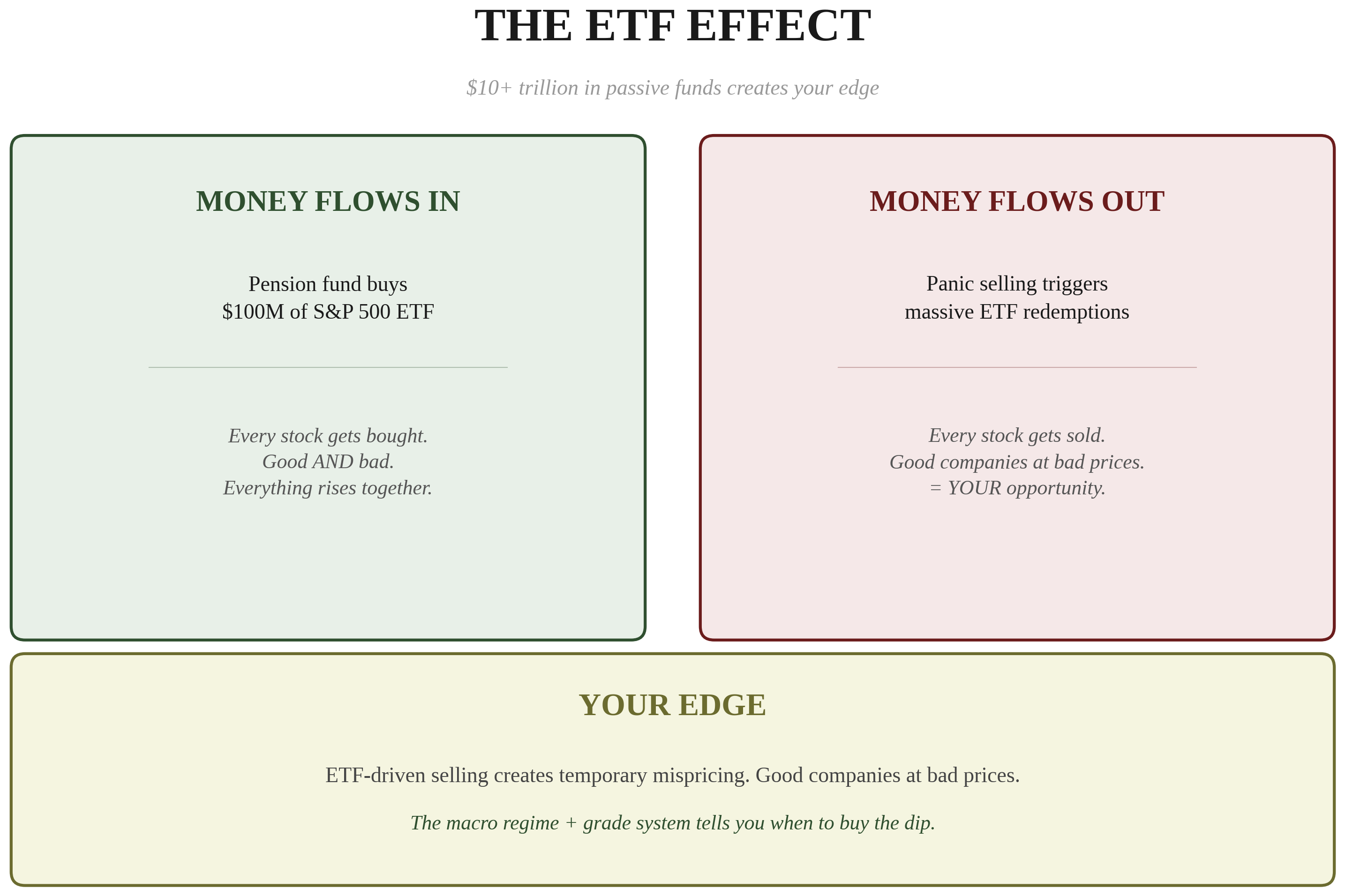
The second massive structural change is the explosion of ETFs — exchange-traded funds. Over $10 trillion now sits in ETFs globally. And this number grows every year.
Here's why this matters. When a pension fund puts $100 million into an S&P 500 ETF, that money doesn't go to the best companies. It goes to every company in the index, weighted by market capitalisation. Apple gets a big chunk. The 400th-largest company in the S&P — a mediocre business with stagnant revenue — also gets bought. Not because anyone thinks it's a good investment. Just because it's in the index.
This creates a bizarre dynamic that didn't exist twenty years ago. A terrible company inside the S&P 500 gets bought purely because money is flowing into the index. A great company outside the index gets ignored. Price disconnects from quality.
But the flip side is devastating. When money flows out, everything drops — even things that shouldn't. During the sell-off in late 2018, high-quality companies with growing earnings and rock-solid balance sheets fell 20% purely because they were in an index that was getting redeemed. The selling had nothing to do with their fundamentals. It was mechanical, indiscriminate, and temporary.
ETF-driven selling creates temporary mispricing — good companies at bad prices, available for a few days or weeks before the market corrects the error.
If your macro framework tells you the economy is healthy (Regime 1 or 2) and a quality stock has been dragged down by ETF outflows, that's a potential Grade A opportunity. The system tells you when to buy the dip that the machines created.
Information Is No Longer an Edge
In your grandad's era, information was the edge. If you knew something before everyone else — a new product launch, a management change, a supply shortage — you could trade on it and profit.
Today, information is essentially free and instantaneous. An earnings report hits the wire and every algorithm on the planet has read, parsed, and traded on it within milliseconds. By the time you read the headline, the price has already moved. By the time you form an opinion about it, the opportunity is gone.
The edge is no longer in knowing things faster. The edge is in processing things better. Specifically, it's in having a framework that tells you what matters and what doesn't.
When a jobs report comes out and the market moves 1%, most traders react emotionally. "The number was bad, I should sell." Or "The number was good, I should buy." They're chasing the headline.
A trader with a macro framework asks a different question: "What does this data point mean for the direction of growth and inflation?" If it confirms your existing regime analysis, the trade doesn't change. If it signals a regime shift, you adjust. Either way, you're processing information through a structured lens, not reacting emotionally to noise.
The Speed Trap
Modern markets create an illusion that you need to be fast. Prices move in real time. News breaks every second. Social media is an endless scroll of opinions and hot takes. The message is clear: if you're not plugged in, you're falling behind.
This is a trap. Speed is the algorithm's advantage, not yours. If you try to compete on speed, you will lose every time. You cannot out-fast a computer. You cannot out-react a machine that processes data in microseconds.
Your advantage is the opposite of speed. It's patience. It's process. It's the ability to sit back, assess the macro environment, wait for a Grade A opportunity, and then act with conviction — and if you want that process handed to you each morning, start a free trial. The algorithm can't do that. It's optimised for the next 200 milliseconds. You're optimised for the next 200 days.
The macro regime lasts months. A Grade A trade develops over days to weeks. None of this requires speed. It requires clarity, discipline, and patience — three things that no algorithm can replicate.
Why You Need a System Now More Than Ever
Markets have always been hard. But the structural changes of the last two decades — algorithmic dominance, ETF-driven flows, instantaneous information — have made them lethal for anyone trying to trade without a system.
Sees red on screen after a bad jobs report. Panics. Sells stock positions because "the market is crashing." By the time they've logged in and hit sell, the algorithms have already found a floor. The S&P bounces 30 points. They sold the bottom.
A disaster of a Tuesday.
Didn't even look at the screen during the selloff. Checked grades at 9am. Nothing changed. Macro regime is intact. Positions are still Grade A. Updated entry and exit signals and went for a walk.
A non-event of a Tuesday.
The casual trader who reads a few articles and places a few trades based on gut feel is going to get systematically destroyed. They're not competing against other casual traders anymore. They're competing against machines and institutions that have every mathematical advantage.
But the trader who has a macro framework, a grading system, defined entry and exit criteria, disciplined position sizing, and the patience to wait for Grade A trades — that trader has something the machines don't. They have a multi-timeframe, multi-factor, human-in-the-loop process that combines the best of both worlds. You can see example signals to understand what this process looks like in practice.
The game has changed. It's harder than ever for the undisciplined. It's easier than ever for the systematic.
The noise has increased, but so has the opportunity — if you know how to filter it.
You now have the foundation. You understand that price is primary, how to read charts, why most people lose money, and how the game's structural changes affect your approach. In the next section, we apply all of this to the first trading style: swing trading — the approach that, for most people, is the sweet spot between effort and return.
Part Two complete. Next: Part Three — Swing Trading. The approach that fits your life and still beats the professionals.
- 1.60-80% of all trading volume is algorithmic — you cannot compete on speed, so compete on timeframe instead.
- 2.ETF-driven flows create temporary mispricing — good companies at bad prices — which the macro + grade system can exploit.
- 3.Your edge is patience, process, and macro awareness — things no algorithm can replicate.
This content is for educational purposes only and does not constitute investment advice. Trading and investing involve substantial risk of loss. Past performance is not indicative of future results. Always do your own research and consider seeking professional guidance before making financial decisions.